Tuesday, January 1, 2013

Spinal Tap and the C.S.A. Live: An Analysis of the Various Forms of Mockumentary Techniques


The following is a deviation from my typical video game themed posts.  The final paper of my documentary class, where I analyze the effectiveness of two mockumentaries (comedy films that use the style of a documentary (though the events in the movie itself are staged and often used with actors) to give the film a false sense of authenticity).  If you have not seen either of these movies, I would highly suggest you watch both of them.  
.           .          .             


This Is Spinal Tap is certainly an interesting film.  With its larger than life characters and ridiculous situations, any observant viewer of the film would find it obvious that the film is a parody of concert films and biopic documentaries, rather than a completely legitimate film about the band “Spinal Tap.”  Yet, the film’s director, Rob Reiner, once noted that while more critical and “sophisticated” audiences in urban areas (New York, Chicago, Los Angeles, and Toronto) easily determined the film’s falsity and thus enjoyed its humorous nature, not everyone could see through the ruse (Platinga, 320).  Reiner notes that when they showed the film to an audience in a Dallas shopping mall, the film was noticeably less successful.  “A small section of the audience laughed,” he says.  “The rest asked why we would make a serious documentary about a terrible band they had never heard of” (Platinga, 320).  Now, many more conscientious viewers and film buffs would find this reaction baffling.  How could anyone find a film that features exploding drummers, cartoonish characters, and such bizarre and awkward situations to have any appearance of validity?  How can anyone actually believe that lead singer David St. Hubbins’s assertion that “dozen of people die from spontaneous combustion every year”?  The answer, put simply, is the execution and style of the film.  Through an expert replication of the same styles used in other concert films and direct cinema documentaries, This Is Spinal Tap makes itself seem like every other documentary because it looks and acts like every other documentary of this style.  Through meticulous camera work and editing, the film is able to perfectly replicate the direct cinema style, and thus Spinal Tap comes to life, regardless of how cartoonish and childish they are.  This is what every mockumentary must do to ever try and convince an audience of the “veracity” of their film.  And films like This Is Spinal Tap and the Ken Burns parody C.S.A.: The Confederate States of America, accomplish this with remarkable ability.
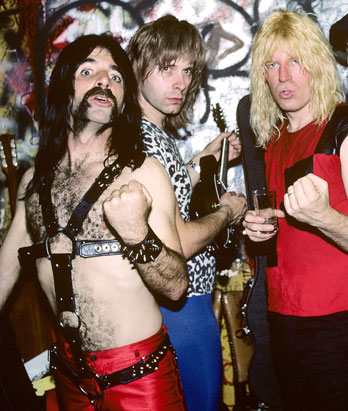
These three seem totally relatable and likable.
But how in particular is this possible?  Let us use This Is Spinal Tap as our first example.  What exactly did Reiner do to make the characters of Spinal Tap “come alive?”  It is certainly a hard task to accomplish; the characters, as mentioned, certainly aren’t “normal.”  They are larger than life parodies of every stereotype of the heavy metal and rock genre, with everyone serving a particular role, from the overly macho lead guitarist Nigel Trufel, with his phallic use of the guitar and his complete lack of knowledge of his own instrument, to bassist Derek Smalls, who tries (and fails) to embody the “silent intellectual” trope often associated with rock bassists.  Yet, as mentioned, some audiences felt the band was real, and that is due to the stellar acting of the band’s “members.”  The basis of this “believability” was due to the fact that the film was largely improvised, with the actors only having a rough outline of what was going to happen in the scene.  Thus, they were able to create a sense of the band members being real people by giving genuine reactions to the questions and situations they were presented.  With the lack of a “strict” story and script structure found in other Hollywood films, Spinal Tap’s “members” rants and dialogue seems more in the vein of just normal conversation.  A particularly good example would be when Rob Reiner’s “Marty Di Bergi” (an affectionate parody of Martin Scorsese, the director of the concert film The Last Waltz (1970) asks Nigel about Nigel’s amp that goes “up to 11.”  Di Bergi asks why Nigel could not simply have just “made 10 louder”, and Nigel stops for a moment, considering this idea, before sheepishly and childishly replying “but it goes up to 11.”  However, in the moment before his answer, we see the cogs in actor Christopher Guest’s head slowly moving, and Nigel seems a little more human.    His response is still comedic and childish, but as we see him slowly try to put the pieces together, and eventually failing, he seems more like a real person.  If the script was more regimented, and Nigel responded even a second quicker with the same line, it wouldn’t have the same level of believable earnestness the moment in the film does.  Thus, with the improvisation, the film becomes more like a direct cinema film, since the reactions of the characters become (or seems to become) more genuine.  And, in many ways, the members of Spinal Tap become very much like “Big Edie” and “Little Edie” from Albert and David Maysles’s Grey Gardens.  Though, on the surface, both groups seem almost too cartoonish to be real, the way they act and interact with each other creates a layer of believability.  Though both the Beales and the members of Spinal Tap both act in ways that no rational person would ever consider to be true, when we actually meet and witness their interactions, they become “real.”  We can follow their thought processes, and their inabilities and failures to understand “normal” thoughts.  In this way, the members of Spinal tap walk the fine line and explore the beautiful limbo between fantasy and reality.

It goes to 11.  No further questions.
But even if the actors were acting in a believable manner, the film still would have lost some feeling of a “direct cinema” feel if the cinematography was too structured.  If there were too many crane shots or even a use of a more high quality camera, the film would have lost the feeling of an “on the fly” style of filmmaking.  However, Reiner saw to this too, for he “contracted documentary producer Karen Murphy to give the film a surface authenticity, and hired cinematographer Peter Smokler, who had worked on Gimmie Shelter, as director of photography.” (Platinga, 320)  In other words, in order to give the film an aura and feeling of a concert style film, like Gimmie Shelter, Reiner hired producers and cinematographers who had worked on these kinds of films.  To anyone, this concept seems obvious.  Who would know this style of filmmaking better than people with experience?  And it certainly pays off.  The concert scenes in particular are shot in a style very similar to other concert films and even some early music videos, with the camera frequently moving around and creating a rapidly moving cavalcade of dynamic images and angles, making the film’s audience feel like there are witnesses to a true Spinal Tap concert.  But the cinematography is also impressive in many very subtle ways.  In fact, one could say it is the subtle differences that give the film it’s direct cinema feel.  Sometimes, when the camera is moving, it will shake and shift since the cameraman is walking with it, giving the impression that Di Bergi and/or his cameraman is always present in the scene.  Adding to this effect are the times where you can actually see glimpses of Di Bergi, catching quick glimpses of his hat or jacket.  While in a more structured film this would be considered a glaring flaw, the “accidental” inclusion of Di Bergi in scenes makes the camera work seem rushed and in the moment, just like a Maysles film.  There are also many times where the characters in the film look directly at the camera, and then guiltily look away, as if they are remembering they are not supposed to do such a thing.  There are even two occasions where certain characters in the film question who Di Bergi and his crew are, presenting something not even the Maysles have shown: how new people react to the presence of the camera.  These touches, as well as the generally sloppiness of the film’s cinematography (sometimes shots are obstructed or noticeably shaking), give the film the more “direct cinema vibe.”  This, combined with the acting, give This Is Spinal Tap a strange sort of genuineness that can make people believe the band is real.
Reiner's Di Bergi (Left) and Christopher Guest's Nigel Trufel in one of the many "interviews"
Yet, just as there is not only one style of documentary, there is no one style of mockumentary, and just as This Is Spinal Tap perfectly parodies and mimics the style of “direct cinema” documentaries, the 2004 film C.S.A.: The Confederate States of America presents an affectionate parody of the dry style of Ken Burns, the documentary filmmaker famous for his extremely lengthy documentary, The Civil War, that aired on PBS in 1990.  However, before going into how C.S.A. mocks Burns’ style, we must first go into what Burns’ style is.  To put it frankly, Burns’ style is what most people consider when they think of documentary, and features several very particular kinds of footage and techniques.  The most noticeable and recognizable technique is the “voice of God” narration, which drones over the poetic descriptions of battles and the history of the conflict.  It also features many photos, which are panned over or zoomed in on in order to make the shot more dynamic or to shift the focus from object to another.  For example, Burns may focus on a specific area of a painting of a Civil War battle before zooming out to show the rest of the canvas as the narrator drones on, as well as some dramatic music, or a reenactment of a song performed at the time (such as “Dixie” or “When Johnny Comes Marching Home”).  Speaking of reenactments, Burns uses these quite often to convey a certain meaning.  For example, he can just use the marching of feet on the ground to convey a moving army or a firing cannon to convey a battle.  Another common trope of Burns’ documentary is the interviews, or “talking heads.”  From intellectuals to former Senators and even descendants of those involved in the fighting, many people put in their two cents on the importance or significance of a certain event.  Finally, Burns often used different voices to read the letters and diaries of famous historical figures or common soldiers, as if the people themselves are reading the letters instead of the narrator. 

C.S.A. utilizes all of these tropes and more in its portrayal of an alternate history, and while it may not convince any American of its veracity, I can see where it would confuse someone who is not familiar with the history.  From the voice of God narration, to the reenactments, to the “talking heads,” C.S.A. uses Burns’ style perfectly.  In many ways, one could say that C.S.A. uses Burns’ style to point out how ridiculous and manipulative the style is.  For example, in order to create an alternate history, the filmmakers have to use a lot of re-contextualization of certain pictures and documents in history to keep the film somewhat grounded in historical accuracy in order to make this alternate history seem believable.  One scene that caught my eye in particular was the use of photographs of the destruction of a particular city.  In Burns’ film, he never says the name of the city, and merely mentions that the “South” faced terrible devastation in the war.  As one would expect from a documentary, Burns used a photo to convey a meaning he could not really show in detail.  However, in C.S.A., the exact same photos that Burns used to convey Southern destruction were now applied to the North.  In a matter of fact tone, the narrator in C.S.A. tells us that these photos are now supposed to represent New York City’s devastation.  In this moment, I had an experience similar to the viewing of Land Without Bread, noticing the huge assumptions I had made when watching Burns’ film.  I could certainly understand that the narrator of C.S.A. was lying, but how could I be sure that Burns was telling the truth?  In this moment, the makers of C.S.A. were almost pointing out how easily it is to be manipulated by the images and official sounding narrator of a Burns-style documentary.  In fact, this seems to be the main interesting point of the film.  While there are some images that do fail at “reworking history” (some of the fake historical characters have photos that do not match the same grainy quality as others from the Civil War era), many of the created images do make the film seem quite official.  Many political cartoons, paintings, and photographs are either doctored or re-contextualized to have completely new meanings, and have the potential to confuse the uninformed or inattentive.  The Confederate Flag can seem perfectly natural on top of the White House’s flagpole.  John F. Kennedy’s speech about “freedom” during his televised debate with Richard Nixon can take on a whole new meaning when taken in the context of the Confederate system of slave labor.  The footage taken in World War I can be easily reworked to be taking place in Mexico instead of Germany if the narrator claims it is.  And while some images are more humorous in nature, the ability C.S.A. has at creating such an official portrayal of this alternate history is rather startling and disturbing.

Once again, the brilliance lies in the subtleties that make the film very similar to Burns’ The Civil War.   Even the smallest of touches, like the repeated “commercial buffer” of a soldier walking silhouetted across a red sky, with a cursive “C.S.A” imposed over the image, seems almost directly ripped from Burns, just with a different title.  In addition, the “talking heads” segments in both Burns and C.S.A. share a similar tendency to have bizarre angles and zooms on the faces of those interviewed.  While there might be some shots of the interviewees shot from a comfortable distance, other times the camera is zoomed right into their face, sometimes at strange tilts.  In both films, it is jarring, yet it meant to create more dynamic shots.  These talking heads segments also capture the rather long-winded and pompous ways some intellectuals portray themselves on camera, adding in the same dramatic pauses and reactions of hatred or admiration that scholars often present in films like Burns’.  Another good example of these subtleties would be the press conference of fictional senator John Ambrose Fauntroy V (the great-grandson of one of the men who helped to create the C.S.A.).  In an almost direct parody of Bill Clinton’s denial of his affair with intern Monica Lewinsky, Fauntroy denies that his ancestor had “sexual relations” with one of his servants, thus making Fauntroy of mixed blood.  While the scene is indeed humorous in itself, the real magic occurs in the presentation, which marvelously mimics an actual press conference, not only in the camera angles, but even in the low quality camera used, making the scene seem ripped from a cable news channel.
This looks way too familiar.
Another interesting section of the film is not part of the documentary itself, but the fake commercials.  While mainly used for comedic effect and to reflect the new, incredibly racist society that formed under the C.S.A., these commercials are brilliant in their techniques.  From bizarre, Snuggie-style infomercials advertising a tracker collar for one’s servants (featuring the same terrible acting and attractive models that one would find in other infomercials), to an incredibly macho commercial for a cigarette brand called “Niggerhair” (based on an actual product) featuring footage of cowboys and horses in a wide open plain, these commercials perfectly reflect not only the culture of the C.S.A., but mock our own commercials by merely presenting the same footage with small differences.

Thus, by following the styles of the different kinds of documentaries to a striking amount of accuracy, these filmmakers are able to create a surprisingly believable new “reality.”  The question becomes not “how could someone believe a band like Spinal Tap is real?”, but “how can one not be sometimes tricked by the presentation of the films?” In their cinematography and their stellar acting, both films have a lot that could possibly confuse or misinform a less attentive viewer.  And while the situations they portray might be ridiculous, are they ever really more ridiculous than the Beales of Grey Gardens?  Are they ever presented with less matter-of-fact assertiveness than Burns’ The Civil War?  By performing such effective parodies of documentaries, these filmmakers make us aware of the all too common tropes we find and take for granted in documentaries.


WORKS CITED
  1. The Civil War. Prod. Ken Burns. Dir. Ken Burns. PBS, 1990. Digital Distribution.
  2. C.S.A.: The Confederate States of America. Dir. Kevin Willmott. By Kevin Willmott. IFC Films, 2004. Digital Distribution.
  3. Plantinga, Carl. "Gender, Power, and a Cucumber: Satirizing Masculinity in This Is Spinal Tap." Documenting the Documentary: Close Readings of Documentary Film and Video. Ed. Barry Keith Grant and Jeannette Sloniowski. Detroit: Wayne State UP, 1998. 318-32. Print.
  4. This Is Spinal Tap. Dir. Rob Reiner. By Rob Reiner and Rob Reiner. Perf. Rob Reiner. Embassy Pictures, 1984. Digital Distribution.

Monday, December 31, 2012

This is the World that We Live In (Indie Game: The Movie Paper)

The following is a paper I wrote for a documentary class about the documentary Indie Game: The Movie, a movie that I think every self-respecting video game fan should watch.  It's an inspirational piece about the development of indie gems Fez, Super Meat Boy, and Braid.
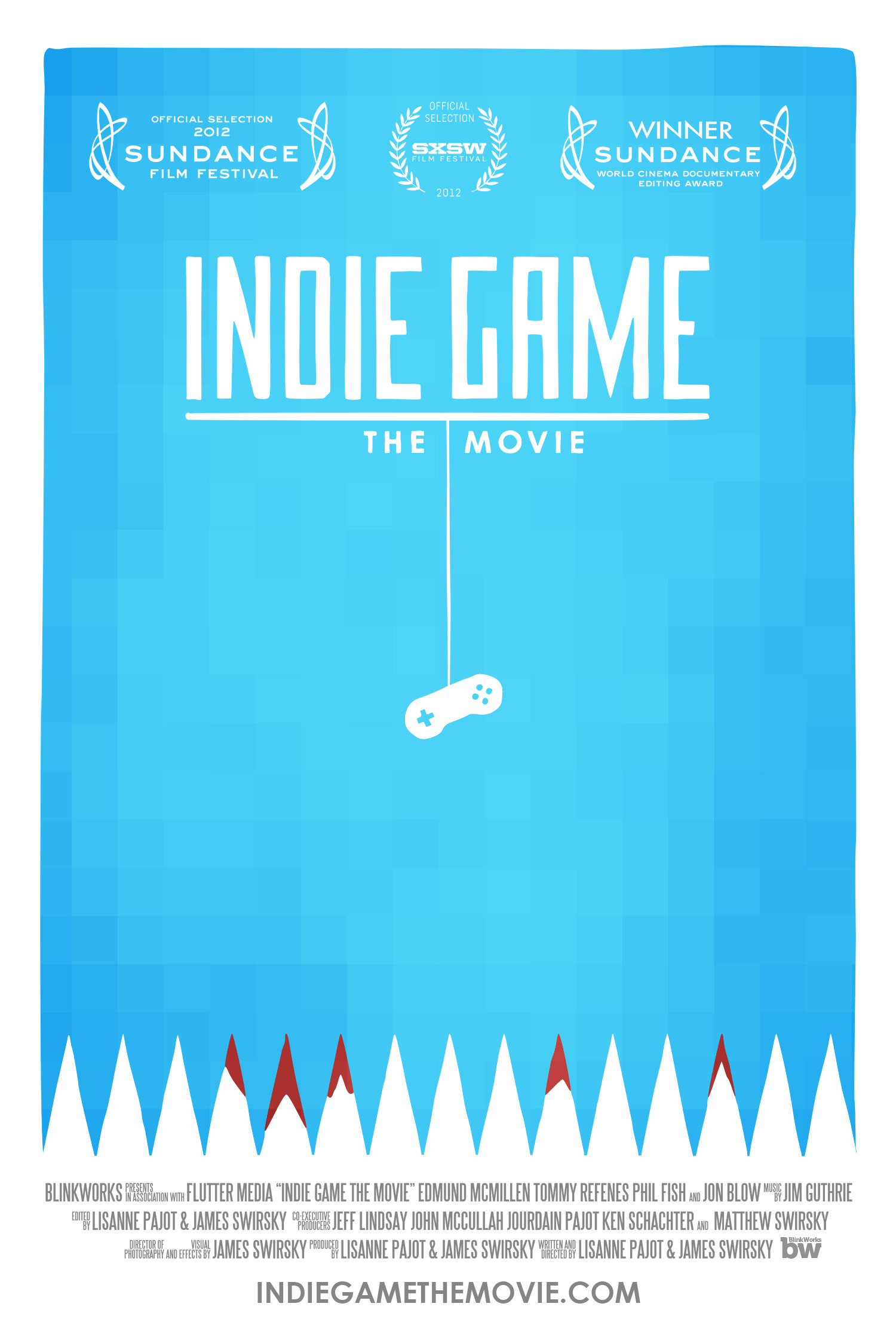
God, do I love minimalist posters.

            To the average viewer of James Swirsky and Lisanne Pajot’s Indie Game: the Movie, the film appears to be just your typical underdog story, with the filmmakers following four “indie game” developers – Jonathan Blow of Braid fame, Super Meat Boy developers Edmund McMillen and Tommy Referens, and Phil Fish, the creator of the recent indie gem Fez – as they slave and strive for success.  But such a simple summary of the film would discredit what the entire documentary truly represents, not just in the filmmaker’s decisions to show the true brilliance of the developers on whom they focus, but also how the developers’ efforts have an artistic meaning.  The film also strives to dispel some of the misconstrued ideas about video game culture and the people who make and play games. For example, video games have often just been seen as a fun hobby to many of the uninitiated masses, something to pass the time and/or alleviate stress, but nothing to fully dedicate one’s life to.  But, through their subjects, but also through their brilliant camera and editing work, Swirsky and Pajot show that this “just a hobby” theory is not true at all.  Video games are not just a hobby; they are a way of life.  Like any other artist, the games are an expression of the creator’s ideals and life experiences.  Therefore, these creators do not just work on and off on these games like anyone else would treat a hobby; rather, like a true dedicated artist, these men work endlessly to create enjoyable, meaningful, and lasting experiences for their player.  This constant dialogue between creator and player, between artist and audience, as well as a true elucidation of what video game culture becomes the grand truth of the story.
Pajot (Left) and Swirsky (Right)
            Let us just focus on the work of the developers and what their projects truly mean to them.  And, to answer that, we must ask the question, “What is an indie game?” On a basic level, an independent (or “indie”) game is a game that is not financially supported by any big name publisher.  As opposed to the better-known titles such as Call of Duty or Mass Effect, an indie game is either financed by the developers themselves, or by a variety of financers that do not represent a company.  For example, Jonathan Blow’s Braid was financed completely by Blow himself.  However, while that may be what be what an indie game is, what an indie game means is quite different, and the answers to such a question might vary.  A developer might make an indie game in order to make friends, to communicate a specific message with the player, or to express themselves and all of their hopes, fears, and vulnerabilities. 
Edmund, and one of his various forms of facial hair.
Edmund McMillen, the creative designer of the game Super Meat Boy and one of the subjects of the film, represents this idea of expression quite well as he describes one of his previous projects known as Aether.  The game follows a young child as he explores space with a strange, octopus-like creature.  As the boy explores the various planets and stars, he meets many of the various planets denizens, most of whom have problems or fears that the boy must solve.  But, as the boy solves more and more the creatures’ problems, the smaller the Earth becomes until he tries returning at the end of the game, and the earth shatters under his weight.  This concept might seem bizarre to the outsider, but to Edmund, the game had deep artistic and psychological meaning.  According to Edmund, the game itself is a commentary on the dangers of isolation and obsession, for the boy is so focused on solving the creatures’ problems (which are the same problems Edmund experienced as a child, including painful stomach aches and extreme loneliness) that he forgets, and eventually destroys, his connection to Earth and the real world.  In many ways, this reflected Edmund’s experiences as a child, when he lived with his grandmother due to a poor relationship with his stepfather, and often felt isolated within himself and his graphic artwork.  To truly convey how much this game means to Edmund, the filmmakers often compare the gameplay of Aether to some of Edmund’s childhood drawings, with one particular drawing of young Edmund imagining himself in space eerily resembling the game as a whole, as if the young Edmund knew he was going to make a game about this exact topic in the future.  

Boy, that's the most adorable psychological trauma I have ever seen.

Even the game focused on in the film, Super Meat Boy, has a large significance to Edmund.  The filmmakers focus on Edmund’s face, and also use clips from the game where the eponymous character dies over and over in the game’s death traps.  Solemnly, Edmund admits that the character is not supposed to be a light-hearted character.  With no skin and constant resurrections from grisly deaths, Meat Boy feels only pain and dread of his next demise.  But, there is more to it than that.  The objective of the game is to rescue Meat Boy’s girlfriend, who is made of bandages.  As Edmund explains how Band Aid Girl completes Meat Boy and takes away his pain, the filmmakers drop heavy hints of this having a double meaning to Edmund, as we see a woman’s hands sewing plush toys of the two characters.  It is only after this explanation that we see Edmund’s wife, who is his moral support, and the relief to the pain and suffering that comes with his artistic mind and pursuits and the constant work that comes with game development.  In many ways, the game presents itself as a love letter to Edmund’s wife and all that she does for him.  When Super Meat Boy is eventually a massive success and critically praised, this is not only a victory for Edmund on a financial basis.  As Edmund tearfully admits, the idea that a child would stay home from school to play his game and be inspired by his life’s work – just as old games were an inspiration to him as a child – is the ultimate victory.  He was able to put himself out in the world, and was not only accepted, but also praised and even adored. For a person who suffered all his life with isolation and escapism, this acceptance means everything to Edmund.
This has a deep meaning.  I promise.
But Edmund is not the only one with something to express.  To Phil Fish, his pride and joy, Fez, is also a reflection of his childhood (which we can see through pictures of a young Phil building Legos, which draws parallels to the blocky, low-resolution design of Fez) and the childlike wonder he experienced with games like Super Mario Brothers, Tetris, and The Legend of Zelda.  Thus, his tragic frustration when everything seems to go wrong in the development process – including losing his fellow developer and then fighting a legal battle over whether Phil can continue making the game, his parents’ divorce, his father’s cancer scare, his loss of a girlfriend, and even the crashing of the Fez demo at a video game convention – not only becomes an affront and problem for the game, but also Phil as a person.  This connection clearly illustrated in a brilliant sequence when the filmmakers cut between gameplay footage of the Fez main character jumping from a cliff into a small pool of water and then, just as the character hits the water, we cut to Phil below the surface of a hotel pool, as if it was one continuous jump.  In one quick moment, we know that Phil and the game are one in the same.  With this in mind, Phil’s rather shocking declaration that he would kill himself if Fez was not released does not seem like much of an exaggeration, since this game is his life.
Suicide has never been more family friendly.
We also have Edmund’s partner and programmer Tommy Referens who, throughout the movie, is constantly stressed and seems quite embarrassed to be in front of the camera.  Though McMillen claims Referens is not as stressed as he is presented in the film, the filmmakers often use Referens to show the dark side of development, along with Fish.  While Edmund seems happy go lucky, Referens works himself to death (somewhat literally as well as figuratively, as the filmmakers constantly focus on Tommy’s poor eating habits and insulin injections).  Thus, possibility of the game’s failure significantly weighs on Tommy since this game has been his work for years.  His sour behavior throughout the movie is not unfounded, and his declarations to just “curl up and die” or just “not do anything for the rest of [his] life” if Super Meat Boy does not do well clearly illustrate how much the work means to him.
Referens
Finally, the same artist-work connection applies to Blow as well.  Though we spend not as much time with Jonathan in comparison to the other developers, he not only represents the aftermath of what comes with an Indie game’s success, but also what happens when the culture surrounding the game does not understand the meaning an artist presents.  Blow has often come under fire for commenting on Internet threads criticizing his game (the filmmakers representing this by not only showing Blow at his computer and the threads with his comments, but also the negative reactions people have had to it (including several videos and blog posts presenting Blow as a know it all or as overly sensitive to criticism)).  But, the filmmakers choose to sympathize with Blow’s pain and his frustration with the massive gaming audience, particularly when they play a video of rapper Soulja Boy playing the game and being more shallowly caught up with the time manipulation technique rather than the complex meaning behind it.  Echoes of Soulja Boy’s review continue throughout Blow’s monologues, with a caustic “this is the stupidest shit ever” reverberated over Blow’s saddened face.  In this moment, the filmmakers truly emphasize how horrible it is when an artist’s message is not accepted, or even considered, by the audience.  For Blow, a rejection of the game is a rejection of the self, and given Blow’s misunderstood persona in the popular culture, it does seem he shares the same fate as his works.
My game is very complex.  You probably wouldn't understand it.
Indeed, the culture and the surrounding video games and these men is another focus of the film, though it is much subtler.  For if we only truly focused on the developers and their side of the story, we would not truly understand why one game succeeds or why one fails.  As mentioned, the filmmakers use constant use of internet forums, YouTube comments, and even interview some members of video game culture outside of development, including Gus Mastrapa of Wired Magazine, Chris Dahlen of the video game website Kill Screen, and Brandon Boyner of the Independent Game Festival, among others.  These men, and the numerous nameless Internet commenters represent the developers’ audience and the more realistic side of the story of game development.  These are the people the developers are presenting their work and themselves too, and the filmmakers show both the good and the bad.  We have the YouTube commenters, infamous for their blunt, harsh language as they curse out Phil Fish for his constant delays on the game.  As Phil vocalizes some of the more common complaints he hears, like “When is [Fez] coming out?” or “Is Phil dead?” we also see the more caustic comments, as one commenter simply states, “Fuck you, Phil Fish.  Fuck you.”  Other commenters on the popular website Reddit upload pictures of Phil with sarcastic text on them, such as “I’m Phil Fish, and I hate my life.”  Indeed, the filmmakers often try to convey how daunting the mass audience sometimes appears to the subjects of the film.  At one game convention, before the doors open and Phil has to present his demo for Fez for the first time in four years, the convention goers are presented in silhouette and in profile (commonly used through the film), giving them an eerily feeling of being a faceless, judgmental mob.  However, when things finally go well for Phil and those at the convention enjoy Fez, we finally see the faces of men, women, boys, and girls as their faces light up with child-like wonder, just as Phil intended.  In these moments, the filmmakers truly try to portray what video game culture is actually like.  While it can seem daunting and overwhelmingly negative on the grand faceless scale of the Internet (whose role in the culture is also emphasized in the aforementioned use of chat rooms and forums), it is the little moments of interaction, and the moments when a creator’s message or game truly hits with the audience that video game culture becomes a wonderful place.  As Phil laughs and chats with the players, we plainly see the dialogue between artist and audience that is so important in any interactive and creative medium, and we see the communication and feeling of camaraderie that is not often associated with the mainstream opinions of video games and the people who play them
This tends to happen after an intense bout of Mortal Kombat on the SNES.
The image often associated with Indie Game: the Movie is a Super Nintendo controller wrapped around a telephone wire like old sneakers, showing how video games are like a neighborhood with its own culture and traditions.  From this culture, there will come artists who wish to use this medium to express themselves.  The film’s subjects all are products of the video game culture who wish to share their life experiences with the world, and, as the filmmakers constantly strive to show, only video games (and indie games in particular) can be used to truly achieve this goal.  When we look at clips of Edmund’s old projects (with them ranging from bizarre, like a game about a creature who solves problems by vomiting, to the just plain absurd (a penis fighting an enormous vagina)), he explains to us that he has always been interested in pushing the limits of what can be done in video games and in culture in general, and AAA games (games produced and financed under a publisher) are too caught up in how a game will sell.  It is only through independent games can people like the film’s subjects can produce such wild ideas and go against the conventions and the norm.  It is only through this medium and lack of restriction that the audience can go past the exterior, and we can truly learn what these men are about.  In the final moments, in the “where are they now” sequence of the film, the viewer watches as Jonathan, Tommy, and Edmund begins production on new projects.  And those declarations are the firm example of why video games are an art like any other medium, such as literature or film.  No matter how painful the experience is when one makes a game, the developers eagerly jump into their project.  For it is not only a passion or a hobby, it is their life.


Sunday, December 30, 2012

Lore and Story Telling

Another day, another post.  The following two emails are about a topic that is close to my heart: video game story telling.  Of course, as with all mediums, I have personal preference on how to properly tell a story, with the appropriate amount of subtlety and interaction with the player.  Hopefully the two emails seen below, as well as the commentary I provide can help detail my positions.

The following is from a commenter from my friend Simon Wu's website, http://gameinsight.org.  The member, named Whiplash, provided the following commentary on story telling:
I was listening through the podcast one night when I heard John Tarr's thoughts on the Mass Effect 3 ending. Him calling the stories "fanfiction" put a smile on my face. But then I remembered something he mentioned back in his Dark Souls walkthrough. He blatantly denounced that the game has no story, and although he's partially right, there really is a story to be had in Dark Souls. That, and he clearly hasn't watched EpicNameBro's lore series of Dark Souls. I saw his pretentious comment as sheer blasphemy of the nth degree. It got me in the topic-writing mood and began conceiving a topic to discuss about, which so happens to be the one right here.

To state that a game has no story without putting any decent form of effort to interpret the meaning behind the game is to cut off the opposable thumbs on your hands and attempt to grab an object without dropping it. Any form of entertainment has a story, no matter how minuscule it may seem. One person could manipulate the story and get a completely unique story out of that, while the other might just turn an eye from it, ignoring the "mindless" monologue that is a nouveau closet of the former's vast knowledge of the story that may hold great weight to the discussion.

Going back to John's mindless blabber about symbolism in games and how they are "fucking stupid" as he so elegantly remarked (spoilers, that last bit was sarcastic), he mentioned that we know of the symbolism of the green light in the Great Gatsby. But how did we learn of it? Through long brainstorming of the subject and learning what it may mean or what correlation it might have with atrabilious topics of social commentary or of dodgy, corrosive discussions of world views or of the like. For example, in Gulliver’s Travels, the story as a whole is a cleverly laid out satire and grim social commentary of many discussions, such as human nature and depravity, the European government in the 18th century, and whether mankind are inherently or gradually become corrupt throughout their lives. One does not just immediately "know" about symbolism in a story; it is recognized and learned through patience, hard thought processing, and research of things that may relate to the subject and use of imagery to assess a plot line.

Back to the topic at hand, games can have dark stories such as Gulliver's Travels or of the like, and you would be surprised at how many games can, and have, achieved this in their stories. At this point, I'm sure I've been given a lot of hate for what I said in Episode 10 of the podcast when I said I loved Final Fantasy XIII, but I feel the need to use it as an example once again. If you look at XIII in an objective standpoint, at first glance of the story, there seems to not be anything that would keep someone interested in the plot line, and this will turn off many people with a lesser mind. But I see the story with a different pair of contact lenses. I see a more dark and gritty shape, one that leaves a great amount of left over food for the brain. I can only assume I pieced this all together and hasn't been discussed before, since we all know the critical backlash of the game, but I digress.
Whiplash continues with a comparison and his own fan theory on how the story of the game Final Fantasy XIII is an allegory for " Slavery movement during the 16th-19th century in America."  That will not be included, due to lack of relevance to this post.  But he finishes his email with the following paragraphs:
And while I'm talking about Demon's Souls and Dark Souls, let me discuss about lore. I find that stories that are non visceral and full of substance are the type of stories that add more meat to the story than ones so easily discovered and completely blatant to the point that everyone and their children can understand the story. I don't like stories with extremely clear-cut content that just involve the individual to just hear what's going on in the story; it tends to ruin the experience for me when it comes to understanding what's going on, especially considering that half of the time the stories from "professional fanfic writers"—which isn't saying much— are just contrived to the bitter end.

Tying in with this section of my article, Mass Effect is a great example of what I don't want from a story. I don't want the developers to punch me in the face with the story and spill everything at me with what's happening before me; I want to discover the story in small chunks overtime, and have times where the story is, ultimately, left to the audience's imagination through atmosphere, NPC dialogue, item descriptions and specific items/enemies/etc. in key locations. I want more developers to embrace From Software's approach to story telling where the story is cryptic and unostentatious when attempting to find the story. It isn't something you just find out. You have to take part in learning and researching the story of your own volition. And that's what I love about lore like this: it gets the player involved in an NPR-like discussion of what's really going on in the story.
I soon responded with my own email, which was discussed in the podcast found here: http://gameinsight.org/com-cast/2012/12/24/ep-18-the-aftermath
After reading the email, I have to say I completely agree with the writer's point about lore and story telling.  I haven't played much of Fantasy Fantasy XIII, so I can't verify the slavery allegory, but you know what?  I like that the game has the potential for allegory and a secondary meaning.  To me, that is when a story becomes interesting.  Take Monolith's Condemned 2: Bloodshot.  The game's story, by itself, is pretty awful.  It explains the mystery behind the violence in the game (taking away the mystery, and thus the fear that accompanies it), and inserts a terrible story of cults and ends with the main character with some strange Super Saiyan powers or something.  It's pretty bad.  However, when I played the game, I found that the main character, Ethan Thomas, with his mental instabilities, makes the story much more interesting than it is.  Because Ethan hallucinates entire levels of the game, one begins to question how reliable Ethan is as the first person narrator.  How can we trust if any of the game's events?  How do we know that the whole game is not an extension of Ethan's broken psyche?  This is where terrible stories can become fascinating character pieces.  So, I must say I LOVE fan theories.  And the best games are where there is room for fan theories.
I feel like I should clarify something, that was made I think too much of in the discussion that occurred in the podcast that discussed this email.  Of course, I understand that a game should not ONLY stand on a potential fan theory.  Rather, a fan theory should benefit a well crafted universe, showing the subtleties and potential mysteries of the universe provided.  For instance, the many theories about Lavender Town from Pokemon should not be the sole thing that makes Lavender Town interesting, but should benefit one's experience of playing through Kanto's creepiest town.  So while Condemned 2's story is still terrible, it did not bother me as much, due to the theory I listed above.
And games like Mass Effect, to me, don't have that.  You know why?  Because the story telling doesn't allow for it.  There is no mystery in Mass Effect, because they explain EVERYTHING.  The game doesn't value the intelligence of the player, and doesn't think that the player can piece together the cultures of the world they present (which, I must admit, is detailed and fascinating, though there are some moments of "shameless fan service", such as a race of incredibly beautiful alien women proud to be consorts and prostitutes and have crazy mind melding sex powers...yeah, OK.  Sure.  Whatever.)  Look at this video from Internet Celebrity Arin "Egoraptor" Hanson, where he describes how the Mega Man games let the player figure out how the mechanics of the game work naturally and without text or explanation.  If this technique works for gameplay, can it not work for story?  I say that it can.

I think the games I like most are where the player has to piece together the stories from the evidence presented.  Games like Dead SpaceBioshock, and Red Dead Redemption rarely or never openly explain what is going on.  They present a variety of evidence, and the PLAYER, not the GAME, is supposed to figure out how it works.  Bioshock's Audio Diaries are not presented in a neat and tidy order or feature an exact explanation of how Rapture went wrong.  They present a variety of viewpoints and opinions that are satisfying to listen to in themselves and are like the puzzle pieces to Rapture's grand and complex narrative.  John Marston in Red Dead Redemption never gives his life story in a "smack across the face" way that Mass Effect would.  Keeping things natural and sticking to the character's personality, the writers kept John's dialogue vague as to hint at how he is trying to forget his past.  Any concessions of his past are usually begrudging and terse.  You know, like a person would, rather than an exposition dump. 
Take a notice on the emphasis I place on player interaction and effort on the player's part to try and piece together the story.  When one reads a book, one is not explained the subtleties, allegories, references, and metaphors that make up a novel by Orwell or a play by Shakespeare.  The reader and the scholar are left to discuss and debate it.  Why should video games be different?
However, Dead Space is the best example of a "Show, Don't Tell" writing style that I have always been raised and taught to be the best form of story telling. After two games and number of movies, books, and comic books, the mythos and history of the game is still vague.  We still aren't sure what exactly the tenants of Unitology are, or what exactly the markers do. We certainly have a lot of hints and can try and piece together a theory, but if Dead Space was told like Mass Effect, I'm sure we would have someone explain every little facet of the Unitology religion in minute detail.  And then we'd read a codex article about it.  And then I'd lose all interest, because it feels more like I'm sitting through a Ken Burns documentary than a living, breathing world, where such things are supposed to be common knowledge. 
Once again, note that is a personal preference.  A lot of people responded to this email that they in fact enjoyed this kind of story telling.  While they realize it has no subtleties, they still can be interested and even engaged with such long winded story telling.  If you do enjoy this kind of story telling, that is perfectly fine with me.  I just can't find it interesting.  According to one commenter, I am in the "very vocal minority" about this issue.
The difference between the two is that games like Dead Space know that when you enter a new world, you are an outsider to this world looking in, and the characters in this world are carrying themselves without knowledge of their presence, so they don't care about explaining everything about their world.  Why would they?  Why would you detail everything that is considered common knowledge?  We certainly don't do that in normal day life.  And I know the Mass Effect argument is that Commander Shepard doesn't know the cultures that he encounters, but I've never liked that argument.  This guy, who is supposed to be the top military commander on Earth, did not learn anything about the cultures he would be interacting with?  WHY?  Was that part of his training?  Shouldn't it have been?  It seems like a bullshit way to try and fit in discussions of the various cultures.
Look, I'm not saying Mass Effect is a bad game series.  In fact, I hold ME as one of the most well designed games of all time, and applaud its emphasis on story and world building.  I just have A LOT of complaints with their execution of story.  Oh, it has it moments of tense or though provoking moments, but to get there you have to slog through hours and HOURS of standing around, staring creepily into an NPCs face, and listening to their life story or the tenants of Asari Culture.  
Apparently, the explanation for this problem I had is that while Commander Shepard can know about the military facets of each culture, he is unfamiliar with the other facets.  I counter with, why would he care?  Sometimes it is relevant to the mission he is involved in, but other times, it just seems like annoying filler.
At least RDR saved these moments for when you were riding on horseback so the discussions became the most interesting part of riding to missions with someone.  You could learn about the same things as Mass Effect (philosophy, foreign cultures, political discourse), yet your doing this while riding into the sunset, or on the way to or from a gun fight.  In addition, the dialogue is written and voiced in a way that seems natural.  Mass Effect's always felt a little bit stiff and robotic to me, like I was talking to animatronics from "It's a Small World" while RDR's felt like real people.
THIS right here I think is the most important point and the main problem I have with Bioware's games. I don't mind talking in games.  It has to be done, and it would seem unnatural to play a game where no one stops to have a normal conversation, but in Bioware games, this can make up over 50 to 60% of the gameplay.  THIS is where I find conversations to be frustratingly uninteresting.  Bethesda games, for example, have a tolerable amount of dialogue, keeping it down to about 5 to 10% of the game.  ONCE AGAIN, this mainly concerns personal preference.
Let me summarize my thoughts by using one of my favorite teaching examples of the last year: Skyrim.  Two moments in particular stand out to me as interesting storytelling.  The first is the opening minutes.  Now, the very famous Internet show "Extra Credits" has torn this moment apart, saying this moment presents too much information for a player at once, putting in too much jargon for a person to be comfortable or interested in.  I disagree.  I had never played an Elder Scrolls game before, yet, hearing all this stuff without an explanation for what it was, it made me WANT to know.  Who are the Stormcloaks?  Who are the Imperials?  Why is Ulfric so important?  By having the game throw me in the world without giving a damn of whether I knew what was going on is a risky move, but here, it made me very excited to explore and find out as much as I could.  The other example is, well, everything else in Skyrim.  Every cave feels like it has a story that one can make up in his or her head.  Why are the Foresworn in this cave?  What is this burned down house in the middle of nowhere?  Where are the inhabitants?  Who are the dead men that became Draugrs?  How does one even become a draugr?  Once again, Mass Effect would have probably had a five minute tragic backstory that would have killed my interest, but Skyrim doesn't have that.  It's silent, leaving me to ponder what happens.  It shows, but leaves the player to tell.  This is what Condemned does with Ethan's psyche.  While the "telling" of cults and superpowers ruins the narrative, the silent conveyance of Ethan's instabilities piques much greater interest.
Others have shared my interest in creating interest for the numerous caverns of Skyrim.
Maybe it is my educational background, but I have always found such things to be much more interesting than anything Mass Effect does.  Oh, Mass Effect has a great world, but it seems like they are trying too hard to throw in everything they created.  It's like when you gather quotes for a paper, you try and fit them all in because you put all this effort in, even if they don't fit or feel natural.  And that's when I lose interest.  Also, they could help to work on their facial modeling and animation.  I'm getting kind of sick of the "Bioware face." 
So I hope that clarifies my preferences in story telling.  I still perfectly accept all various points of view and preferences.  Yet this is just what I like and dislike.

Saturday, December 29, 2012

It’s a Bird, It’s a Plane, It’s…


Once again, it has been a while since my last post, due to Georgetown's finals and Christmas festivities, I have been extremely busy these last couple of weeks.  But, to make up for the lack of posts since school started, I will be posting one post a day for the next week or so.  These mainly consist of papers and lengthy emails I have made about movies, comic books, video games, etc.  

This first post is a final paper from Fall of 2011, my first semester at Georgetown.  For some reason, my class about the Post Modernist period in literature allowed us to write about anything from the period, not literature in particular.  But, if I got the chance to write about Superman, I wasn't going to complain.            

     .         .        .

I'm amazed Superman could fight crime with his eyes closed all the time.
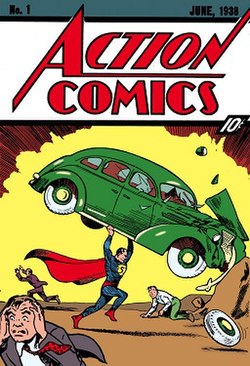
               Harold Donenfeld, the owner of the relatively new Detective Comics publishing company, had no idea what to think of this startling development.  When he published the “Superman” story in Action Comics #1 a few months back in June 1938, he worried that the character would be too fantastical for audiences to handle.  Thus, in the following four issues of the line, he kicked the red-and-blue muscle man off the cover and returned to the safe and familiar pulp stories that he knew people loved.  He felt fully confident that the character would merely fade into obscurity, leaving him to one day scratch his head and wonder why he would ever publish such a ridiculous tale.  A man from space, endowed with the powers of a god, lands on earth as a baby and dedicates his life to fighting crime, while disguising himself as a weak-willed, pathetic journalist; who would buy that?  Who would believe it?  According to a newsstand study that Donenfeld requested, a lot of people would.  In fact, while other comic book titles only sold up to two hundred thousand comics per issue, the Action Comics line repeatedly sold over half a million copies (Bongco, 95)!  More fascinating, however, was the fact that despite Superman’s removal from the cover, children continued to request “the comic ‘with Superman’” rather than Action Comics (Bongco, 95).  After the survey, Donenfeld decided to put Superman back on the cover of Action Comics, trying to prove to himself that it wasn’t a fluke, and watched each succeeding issue sell out. 

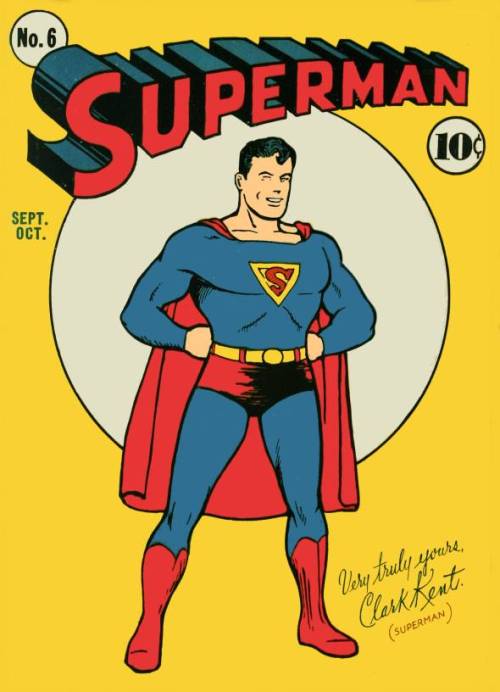
Superman: Keeper of truth, justice, the American way, and smashing the fuck out of people's cars when they double park.

His mind was blown.  Every notion that he, and many other publishers, had conceived about the comic book industry had been blown.  To think that two introverted teens from Cleveland had somehow created the perfect comic book character astounded him, as did the idea that the two had failed to sell their idea for years with no luck because editors had the same line of thinking as he did.  Amazingly, by taking this chance to publish the story that no one else would, Donenfeld had stumbled onto a cultural and financial gold mine.  Soon, Superman would have his own radio show and become a staple of American culture.  Even in the mere months after Superman’s monumental success, dozens of imitators would begin to pop up out of the blue.  Men in capes and masks fighting crime, including bizarre creations like the “Bat-Man” and “Captain Marvel.”  No one, not even the Man of Steel’s creators, really knew how it happened.  To everyone, it seemed like unexplainable luck.  Yet, given the factors behind his creation, such as his appeal to the children and adolescents that eventually became his main reader base and the time in history he was published, Superman was, in many ways, destined to succeed. 

Take the influences and early lives of Superman’s two creators, Jerome “Jerry” Siegel and Joseph “Joe” Shuster, whose age was a huge factor in Superman’s appeal.  When they developed the concept of Superman, Siegel and Shuster were the same age as the children and adolescents who became the Man of Steel’s biggest fans.  The two Cleveland boys knew their own personal interests and emotional struggles and knew to tap into these interests and emotions to make Superman appeal to themselves, and thus any potential readers of their own age group.  In other words, they wrote Superman as much for themselves as they did for anyone else.  For example, Siegel himself noted that Superman rose from his “own personal frustrations,” which were quite prominent and overbearing due to the fact that Siegel was an introverted bookworm who was bullied by his classmates and completely ignored by the beautiful girls he adored from afar (Siegel, “Happy Birthday, Superman!”).  Perhaps, he thought, he could finally get the respect and attention for which he constantly yearned if he “could run faster than a train, lift great weights easily, and leap over skyscrapers in a single bound” (Siegel).  Thus, when creating Superman, he knew that he wanted to create two sides to the Man of Steel in order to obtain his personal wish fulfillment (Siegel).  He knew that Superman’s alter ego, Clark Kent, would have to be a stuttering, pathetic mess of a man that perfectly mirrored the inhibited, intellectual appearance of Siegel and his friend Shuster (Siegel).  Indeed, the bespectacled Kent possessed many of his creators’ traits, from his ineffectual wooing of the tough and independent Lois Lane to his timid and cowardly nature.  In fact, even Kent’s reporter position was similar to Siegel, who was a constant contributor to his school paper (Siegel). 

Siegel (Left) and Shuster (Right)
Yet, as everyone knows, Kent’s timorous behavior is just a front.  With a removal of his glasses, Kent becomes Superman, “a physical marvel, a mental wonder…destined to reshape the destiny of the world” (Siegel and Shuster, 13)!  Clark Kent may be just a face in a crowd, someone who is overlooked or even shunned by all his peers, but by a simple costume change, he becomes the person everyone adores!  Yet there is more to this transformation than just the drama it provides.  When writing,
Clark Kent personifies fairly typically the average reader who is harassed by complexes and despised by his fellow men; through an obvious process of self-identification, any accountant in any American city secretly feeds the hope that one day, from the slough of his actual personality, a superman can spring forth who is capable of redeeming years of mediocre existence. (Umberto and Chilton, “The Myth of Superman,” 15) 
Umberto and Chilton point out exactly what makes the dichotomy of Superman and Clark Kent so appealing: adored by women and feared by the bullies of the modern world, Superman is not only the epitome of Siegel and Shuster’s desires, but of the desires of many young children and adolescents who experienced the same self-consciousness and feelings of isolation as Siegel and Shuster did, and this desire to be noticed, adored, and respected by one’s peers despite one’s physical and social inadequacy is what makes Superman such an engaging and inspirational hero.
He's also one hell of a dancer.
Yet, as appealing as such a simple transition sounds, this dichotomy would not have been as influential if Superman’s grand adventures did not perfectly reflect the culture and/or respond to the emotions of the late 1930’s.  While Superman’s dichotomy and simple transition from unknown to idol would have probably appealed to most people at any time, it was especially potent during the 1930s, a time when society was becoming more mechanized, and men desperately tried to cling onto their individuality in spite of society’s trend of forcing them to feel like numbers and statistics (Umberto and Chilton, 14).  The general public needed to find someone that was above the trivial pressures of modern life, like the failing economy and the increasing mechanization of labor, and Superman became that person.  He stood above the skyscrapers and machinery and became almost a mythological figure. 
Superman's going to give Adolf a stern talking to.
Furthermore, by reflecting the culture trends and media of the 1930s, Superman was a modern and present hero, and was much easier to explain and understand than most future based comics, like Flash Gordon.  Throughout Superman’s romp in Action Comics #1, the dialogue was rich with slang, such as “seeing pink elephants” as a reference to inebriation (Siegel and Shuster, 10).  As mentioned before, Kent’s romantic interest, Lois Lane, was a strong, independent woman and a fellow reporter rather than a repressed and obedient housewife.  The art in particular was heavily influenced by pulp art that was popular in comic books at the time, with Superman looking more like a bruiser than his more graceful modern depictions, and his costume was influenced by the artwork of muscle-building magazines, which Shuster frequently purchased and were quite popular at the time (Benton, 12).  Even the name Clark Kent was influenced by actors Clark Gable and Kent Taylor, and the concept of a man from space with superhuman powers coming to modern society was borrowed heavily from Phillip Wylie’s 1930 novel Gladiator!  Furthermore, the bulk of Action Comics #1, from the ads to the stories, appealed to children of the 1930’s, and included cartoons of famous baseball players like Lou Gehrig, and caricatures of famous actors.  From cover to cover, Action Comics #1, and its famous creation, was the 1930s.

But more important is Superman’s struggle against social problems that were prevalent during this time.  As mentioned, Siegel noted that Superman was a vent for his frustrations, but it was not only bullies that bothered him.  With a looming World War, a Great Depression, and even a greater awareness to political corruption due to more advanced journalism, children back in 1938 lived in an era of immense fear and anxiety.  Thus, in his grand adventures, Superman tackled these problems.  Specifically in Action Comics #1, Superman confronts a well-known lobbyist who was supporting a mysterious Congressional bill that would have forced the US into the conflict in Europe.  By carrying the lobbyist away to jail (or for more information; the issue ends a dramatic cliffhanger) Superman was doing his part to cut down on corruption (Siegel and Shuster, 11 - 13).  What is interesting about this moment is not only that Superman takes such action, but also the depictions of the ratty faced, conniving lobbyist and the abnormally plump fat cat Congressman he meets with, making it somewhat obvious that two creators were pointing out the people they felt responsible for rampant corruption in government and portraying them in an unflattering way (Siegel and Shuster, 10). 

But what is so special about attacking these modern social problems?  Wasn’t the aforementioned fact that he was above all of this corruption and social pressures enough for readers?  Not at all.  First of all, confronting such problems is what forms the basis of Superman’s appeal: rather than being a ordinary man in an extraordinary place and time, like his predecessors Flash Gordon and John Carter of Mars, Superman was an extraordinary man in a ordinary time and place (Benton, 13).  Unlike those men of pure fantasy, Superman would be doing all he could to attack problems that kids really felt should be fixed in their lives.  This is clearly seen in another segment of the story, where Superman fights and defeats a man who had been beating his wife and reprimands the man as he landed each blow.  Is that not what any child in a house of domestic abuse, or even a friend of such a child, would love to do?  By taking such action against crimes that have been seemingly ignored by adults, children may see Superman’s fantastical actions as achieving things that adults never could, and the comics provide “an indictment against…older folk who have not succeeded in lessening crime perceptibly or in seeing that justice prevails” (McCarthy and Smith, “The Much Discussed Comics,” 100).  Also, due to the enormous stresses of the time, Superman’s adventures provided a much-needed escape from the disasters that children felt they had no control over.  One child, when asked why he liked reading comics, noted that the bright and colorful pages of his favorite comic book “took [his] mind off the war news for a while,” showing that comics were more appealing to children than ever during a time of constant bad news (Strang, “Why Children Read the Comics,” 339).

There are many other reasons children adored Superman’s adventures, however.  When asked by Dr. Ruth Strang of Columbia University, children provided a variety of responses for their love of comics, thus hinting at why Superman, and the comic book medium in general, appealed to children and adolescents.  It was not only the desire to, as Strang describes it, fulfill their need to “overcom[e], in imagination, some of the limitations of their age and ability for obligating a sense of adventure denied to them in real life” or the release “from feelings of inadequacy and insecurity and fear from aggression toward or from others” as we have described before (Strang “Why Children Read the Comics”, 336).  Some children just read them for relaxation or for mental catharsis from the work of school.  Or, due to the mixture of art and short, yet still descriptive, sentences, some children used them to learn to read, or even to supplement their diction with new vocabulary that could be easily explained by the art provided in the comic’s panels.  This mixture also made reading comics simpler than reading a novel in general, requiring less thinking and strain than what was constantly required at school.  Yet, Superman was quite proficient in two comic book conventions that drew readers back to his comics week after week.  The first can be properly described by a high school boy:
Comic strips appeal to the average reader like myself by three little words, “To be continued.” In almost every case before Superman puts in appearance, Lois, the leading lady of this strip, is ready to lose her life.  Just when death is about to strike, “To be continued” pops up, and the reader anxiously waits for the next issue in order to see how Superman pulls Lois out of this one.  These adventures go on forever. (Strang, 340) 
In other words, by leaving the reader in suspense of what is going to happen next (like Action Comics #1 did), Superman not only makes the reader care about his adventures and even his supporting characters, he makes the constant saving of Lois or the constant battling of evil never lose its luster, even if it is a situation a reader has encountered many times before.  By leaving those three words, a reader’s imagination takes off, letting them wonder what could possibly happen next.  The temptation and excitement to see if what they have predicted comes true is too alluring to resist, and Superman continues to draw their interest. 

WHAT DOES IT MEAN?
            The second trait provides the answer as to why Superman’s adventures never seemed too silly or fantastical to readers, as Donenfeld and other editors expected.  One reader mentioned that while she did realize Superman’s actions were indeed impossible, Siegel’s skillful writing and Shuster’s impressively realistic art presented the Man of Steel in such a way that gave the reader a feeling that “it is not fiction but really fact” (Strang, 338).  Indeed, Siegel and Shuster did their best to see that Superman’s romps never become too fantastical, such as the fact that Superman was not able to fly until 1943, well after he was an established character (Booker, 614).   Even in Action Comics #1, Siegel does his best to explain Superman’s powers in ways children can comprehend.  After describing how the residents of Superman’s home planet achieve super abilities when reaching maturity, the narrator answers the reader’s disbelief with a jubilant “Incredible? NO!  For even today on our world exist creatures with super-strength!” before providing the examples of the “lowly ant” that “can support weights hundreds of times its own,” and the grasshopper, that can leap “what to man would be the space of several city blocks” (Siegel and Shuster, 1).  By imposing examples a reader can comprehend and have most likely already learned in schools, and then imposing them onto a man, Superman’s actions become comprehendible and not beyond the limitations of imagination.
            There were, of course, other reasons Superman and the idea of the superhero was not an extreme departure from the norm as many editors believed.  From cinema to plays to classic novels, Superman has had many predecessors that, when recognized, made Superman’s arrival seem more like a grand progression rather than a complete departure.  Beginning in the era before comic books, which author Peter Coogan describes as the “Antediluvian Age,” there have been dozens of men with superpowers, who fought crime and maintained a secret identity, or have gone on grand and fantastical adventures; Superman was merely the first to combine all of these ideas in a pretty red and blue package (Coogan, 127).  In particular, Coogan lists three categories of adventure heroes that Superman eventually encapsulated and even defied: the science-fiction superman, the dual-identity vigilante, and the pulp übermensch (Coogan, 126).  The first category included beings like Mary Shelley’s Frankenstein and H.G. Wells’ The Invisible Man, and was often defined by a character that is somehow more evolutionary advanced than those surrounding him.  Superman defied this concept, however, for while the usual character was often tragic, considered an outcast, and eventually grew to look down upon his supposed inferiors, losing whatever humanity that remained, Superman remains completely supportive of his adoptive planet and its inhabitants, and, in turn, most of the planets residents support him.  

Just one of many results for a "Frankenstein Superman" Google Search.

The “Dual-Identity Vigilante” has been around since the times of Robin Hood, but regained popularity with Baroness Orczy’s The Scarlet Pimpernel (1903), which featured a French aristocrat dressing up as The Scarlet Pimpernel in order to save other aristocrats from the guillotine in revolutionary France.  Like Superman, the Pimpernel also had a pathetic alter ego, Sir Percy Lord Blakeney, whose “wimpy playboy secret identity…contrasted with the stronger hero identity” (Coogan, 156).  Superman defied this definition as well, for Clark Kent was even more of a nobody than Sir Percy, making him so superbly average it appealed to children in a time of lesser individuality.  Also, while the masked avengers of this convention were considered criminals for their illegal behavior, Superman fights all crime, respects the laws of the land, and is loved by most of the police and the government (with, of course, some more modern notable exceptions) (Coogan, 154). 

It's because nobody cares about you, Clark.
Finally, the pulp übermensch included men like Edgar Rice Burroughs’s Tarzan (1912) and the character Doc Savage, both of whom influenced young Siegel and Shuster.  Yet, while these characters were often called “supermen,” in was more in the vein of a “physically and mentally superior individual who acts according to his own will without regard for the legal strictures that represent the morality of society” (Coogan, 162 – 163).  Superman, of course, would never go against the wishes of society, and in many ways, he defines them. Yet, despite this contradictions, Superman stills owes his origins and success to these characters, for, as Coogan notes “by the time of Superman’s creation, these conventions so suffused pulp fiction that their presence in the color-costumed adventures of superheroes would go unquestioned” by readers (Coogan, 157).

That's not to say he hasn't done stupid shit in his 70+ years of comic history.
            But Coogan also notes that while Superman may not be the first superhero – mentioning characters like Popeye, Hugo Danner from the book Gladiator, and even another character by Siegel and Shuster known as Dr. Occult, who even featured a similar color scheme to the Man of Steel – the Last Son of Krypton was the first character to “fully embody the definition of the superhero and prompt the imitation and repetition necessary for the emergence of a genre” (Coogan, 175).  And he did so by presenting the three features of every Superhero that followed in his footsteps – mission, powers, and identity – all in the first page of Action Comics #1.  After discovering his fantastical powers, including running faster than a train and deflecting bullets off his skin, a young Clark Kent states his mission, dedicating his life to using these powers “into channels that would benefit mankind” and, at the bottom of the page, he stands triumphant in the his famous costume, thus presenting his identity (Coogan, 175).  And while some other characters may have had these concepts before, Superman was both the first to combine them and to, as Dr. Randy Duncan and Dr. Matthew J. Smith note, redefine these concepts that fit his hero personality.  In particular, the two point out that Superman’s mission is completely pro-social rather than self-serving, so he is not fighting criminals for his own desires and drives or out of vengeance, he is doing so to solely benefit society.  And when it comes to identity, Duncan and Smith note that Superman’s mission and powers are perfectly represented in his image.  Not only do the bright colors of his costume reflect the fantastical nature of his powers and deeds, the famous “S” on the Man of Steel’s chest becomes what the two define as a “symbol signs” – “an arbitrary pattern…that reference an idea or thing” – of both his mission and his desire to help others. (Duncan and Smith, 320).  That is why the colorful picture of a man lifting a car above his head while wearing blue and red tights did not confuse the reader or dissuade them from buying the comic as Donenfeld expected.  More likely, it fueled interest!

            This is just a sampling of why Superman was so influential and destined to succeed.   The culture Siegel and Shuster were raised in, their interests, their early lives, and even the books they read, all came together to form a new, yet not radically different, character that perfectly represented both the ways of American culture and the wish fulfillment of young children and teens living in Depression-era America.   Yet, as Duncan and Smith point out, superheroes were not only tales that inspired wish fulfillment, they became an “optimistic statement about the future and an act of defiance in the face of adversity” (Duncan and Smith, 243).  Superman was not only the hero everyone wanted to be, he was hope in a time of poverty and looming war.  He came when America needed him most, just as he always does in the comics.  Thus, it is no wonder why something so powerful, so fascinating, and so comforting would sell prolifically, and become the definer of the American culture.


God DAMN, my patriotism is so rock hard right now.
Works Cited
  1.      Siegel, Jerome, and Joe Shuster. "Superman." Comic strip. Action Comics #1 June 1938: 1-13. American Studies @ The University of Virginia, Dec. 2000. Web. 12 Nov. 2011. <http://xroads.virginia.edu/~ug02/yeung/actioncomics/cover.html>.
  2.  Benton, Mike. Superhero Comics of the Golden Age: the Illustrated History. Vol. 4. Dallas, TX: Taylor, 1992. Print. The Taylor History of Comics.
  3. Coogan, Peter M., and Dennis O'Neil. Superhero: the Secret Origin of a Genre. Austin, TX: MonkeyBrain, 2006. Print.
  4. Duncan, Randy, and Matthew J. Smith. The Power of Comics: History, Form and Culture. London: Continuum International Pub. Group, 2009. Print. 
  5. Siegel, Jerry. "Happy Anniversary, Superman!" June, 1983. Superman.nu. Fortress of Solitude Super Network, 2008. Web. 12 Nov. 2011. <http://superman.nu/a/siegel.php>.
  6. Strang, Ruth. "Why Children Read the Comics." The Elementary School Journal 43.6 (1943): 336-42. JSTOR. Web. 16 Nov. 2011. <http://www.jstor.org/stable/997772>.
  7. McCarthy, M. Katharine, and Marion W. Smith. "The Much Discussed Comics." The Elementary School Journal 44.2 (1943): 97. JSTOR. ITHAKA. Web. 12 Nov. 2011. <http://www.jstor.org/stable/997572>.
  8.  Eco, Umberto, and Natalie Chilton. "The Myth of Superman." Diacritics 2.1 (1972): 14-22. JSTOR. Nov. 2006. Web. 16 Nov. 2011. <http://www.jstor.org/stable/464920>.
  9.  Booker, M. Keith. Encyclopedia of Comic Books and Graphic Novels. Vol. 1 and 2. Santa Barbara, CA: Greenwood, 2010. Print.
  10. Bongco, Mila. Reading Comics: Language, Culture, and the Concept of the Superhero in Comic Books. New York: Garland Pub., 2000. Print.