Saturday, October 13, 2012

Interview with Tom Fulp and Dan Paladin from the Behemoth

This week's interview is actually a text interview.  Once again, this weekend is quite busy with a large amount of work (Hooray for Midterms!) and Parents' Weekend.  

Yep.  Chickens.
However, this week's subjects, Tom Fulp and Dan Paladin from the Behemoth games, who are responsible for games like Alien Hominid, and the Xbox Live Arcade success Castle Crashers.  With its fun cooperative play and bizarre sense of humor, Castle Crashers was a MASSIVE success, changing the way Xbox Live Arcade played into the online distribution of games for years to come.  With such a massive effect on the game industry, it was obvious that we would interview them.  Mr. Fulp is also previously successful with his website, Newgrounds.com, which features flash animations and games.  Ranging from the brilliant and emotional to the quirky and just plain disturbing, Newgrounds and its users has movies for every type of audience.  But let's begin the interview:

Mr. Paladin (Left) and Mr. Fulp (Right)

1. Castle Crashers has been considered one of the greatest indie/downloadable games of all time.  How do you handle such praise?  Do you feel that the game deserves such praise, or do you feel completely off guard by it?
TOM:  The success of Castle Crashers caught me pretty off-guard. We put a ton of blood sweat and tears into it and expected it to be a bigger success than Alien Hominid, but nothing in the range of two million sales. My personal dream was 250,000 sales; I couldn't imagine much beyond that.
DAN:  Yeah, this was a really amazing surprise for us.  We were proud of our game and thought it'd hold its own, but to be #1 rated ever since release, and to reach so many people.. that's just awesome.  We're glad people enjoy our work this much since we really gave it our all.

2. Your games, especially Alien Hominid, finely walk the line between “fun-challenging” like VVVVVV or Demon’s Souls and  “frustrating-challenging” such as Call of Duty on Veteran.  How did you find that kind of balance in gameplay?
TOM:  I don't consider Alien Hominid's difficulty to be a found balance, it feels like more of a mistake. We fell into the trap of getting too accustomed to the challenges and making it more challenging as a result. There's also just some bad design in general, where death can be unavoidable and a matter of luck. I try to take as many lessons away from it as I can. I still think it came together as a fun and crazy game.
DAN:  I think we just made a very dated mistake.  When it used to just be 1 person total on an entire development team it was easy to fall into a trap.  The way we're built is a lot like that old system.  So, if you know every trick the enemies are going to use, the game can't really be very hard for with that level of understanding.  Being so close to the project, Tom and I could fly through Alien Hominid like it was nothing, and I think we may have tuned it for ourselves accidentally -- although nowadays, being separated from it for so long, I can get my butt kicked by that thing.  Now, we take the game to shows, have more employees, and have a usability lab.. so it's hard to fall into that trap ever again!  Whew!

3. Your games are also very inspired by old school games.  Castle Crashers, in particular, seems to be inspired by beat ‘em ups, like Final Fight or maybe even Golden Axe.  What were your inspirations for each project?
TOM:  With Alien Hominid my personal inspirations were Gunstar Heroes and Metal Slug, although I wish I had leaned more towards Gunstar Heroes than Metal Slug. Any game by Treasure is an inspiration to me.Castle Crashers was a much more varied mix of inspirations, namely every brawler ever made (I've tried to play them all), Guardian Heroes and general RPG influences.
DAN:  I was more or less inspired by the entire genre, or the overall feeling I'd get when playing that genre.  I don't feel like a lot of the games that inspired me nowadays are as fun as they were when I was a kid.  I'd have to say one of my largest influences came from River City Ransom.  That game is still awesome, and has such a nice balance.  To recreate that balance is near impossible.

4. Your games definitely have an “interesting” sense of humor to them, which makes it quite distinct from other, serious indie games like Limbo.  Why did you decide to place this humor into the game?
TOM:  I think that just happens spontaneously. The silly stuff tends to come in the middle of the night, when we've been grinding away at something that has become boring and decide to throw something crazy into it to make it fresh.
DAN:  We just get silly sometimes.  It's interesting how a moment like that can end up being very iconic in our games, like the pooping deer.  Seeing it now, it's really nice that people laugh along with us and get a sense of how we are when they play.

5. As one of the initial success stories on XBLA and the indie game market, do you feel your success has inspired the growth of indie game market?  Do you think we would have titles like Limbo or Cave Story without the success of Castle Crashers?
TOM:  We felt like we had accomplished something big when we got Alien Hominid on PS2 and Gamecube, although for indies the real market change came with downloadable. We faced another challenge convincing Microsoft to let us self-publish Alien Hominid on XBLA; the traditional publisher model was still in place and was being enforced. It felt like we were knocking down some barriers at the time but I can't really speculate on what games would or wouldn't exist without the success of Castle Crashers. I like to think it helped inspire other small teams to aim for consoles.
DAN:  Doesn't Cave Story pre-date us?  Anyway, just due to Castle Crashers' reception, I'd imagine it has shaped a bit of how things are going, but I'm not entirely sure what was shaped and how. I think what Castle showed was not that indie's could be successful on XBLA, but that XBLA was a new legitimate platform in its own right. Many of the top XBLA games, such as Castle, Trials, Minecraft, etc., are from independent studios.


6. Recently, one of your fellow indie game developers, Edmund McMillen was featured in Indie Game: the Movie.  Did you receive an invitation for the film?  Did you want to be featured?
TOM:  To my knowledge we were considered a bit too successful already, since the movie was focusing on developers struggling to break through. It would have been awesome to make some appearances in there, since it's such a great movie, but I'm happy enough that Castle Crashers and Newgrounds got some recognition throughout. The movie did a great job capturing the emotional rollercoaster of game development. I've had to suppress bug-related panic attacks at a lot of conventions over the years.
DAN:  I know we're mentioned in the film, and I'm in it for about 1 second shaking Edmund's hand, but I don't recall being invited.  We wouldn’t have minded giving our angle.

7. Are you close with any other indie developers?
TOM:  I'm close with a ton of developers on Newgrounds, including guys like Edmund and Tommy  from Team Meat and Tyler Glaiel and Jon Schubbe who made Closure for PSN.
DAN:  I know Edmund, Tyler and Jon as well.  Also Jen Zee from SuperGiant, and I've hung out with a few of the Doublefine guys a few times, and the Trap Door guys. We just don’t go out of our way to publicize our “indie friendships” and tag them in every Facebook picture. All of these people are genuine and cool.


8. Have you ever been contacted by a triple-A publisher?  Would you ever take them up on an offer a make a high-profile game?
TOM:  I don't think any of us have any interest in that. The only thing that tempts me once in a while is taking on an established cartoon franchise, especially now that I have kids who love specific cartoons on TV. Working with big companies is such a headache though so in the end it's worth just going your own way.
DAN:  I remember once in Japan that a Square guy came up and said he wanted to work with us.  But, it quickly became clear that we were unable to work anything out that made sense for both companies.  I was initially really excited by the idea, but looking back.. I have no idea what we'd do that I'd feel right with.  In Japan, most developers stick with traditional retail games, which we have moved away from. Downloadable games allow us to create the games we want to make, and on our own terms, and make it available worldwide. 


9. Your next game is BattleBlock Theater.  Could you give us a little bit of info on it?  What were you trying to achieve with it?  The gameplay looks like a very unusual mix of puzzle and platformer.  Is that right?  Or is it something completely new?
DAN:  BattleBlock is definitely its own animal.  It has familiar mechanics, but somehow it wouldn't be a fair comparison to any game I can think of.  It feels very strange just calling it a platformer as it provides both cooperative and adversarial experiences that are unique.  I think we were just taking our stab at platforming and letting the design lead us the way it wants to go.  I think it's accurate to call it something new, which is what makes it so hard to explain.


LINKS:
The Behemoth Website: http://www.thebehemoth.com

BattleBlock Theater Website: http://youtu.be/dxHV5n6AkSI

And, Tom and Dan were nice enough to provide us with their favorite game music.

TOM's Playlist:

The entire Ys 1&2 soundtrack.

Monster Lair

Bonk's Adventure


Phantasy Star


DAN's Playlist:
River City Ransom
http://www.youtube.com/watch?v=k7mpWPKt4wk&feature=relmfu

Warcraft 2
http://www.youtube.com/watch?v=9vGnzKki5aA

Wargasm
http://www.youtube.com/watch?v=8CM2GfniuTk

Kid Icarus
http://www.youtube.com/watch?v=dOg2NWQgltI


Saturday, September 29, 2012

The First Radio Show, and an Interview with "The Stanley Parable's" Creator, Davey Wreden

Well, it's been a while since my last post, but due to work ramping up with upcoming midterms, and all of my extracurricular activities, the blog has been put indefinitely on hold.  I might upload my review of Paul Thomas Anderson's The Master soon, but school work comes first.  

However, one of my extracurriculars is my new radio show on Georgetown University's radio channel, WGTB.  Named "Natural Double d20's," the show features my two friends and I discussing games, movies, and other facets of nerd culture, as we would on this blog.  The links to our Facebook page, as well as the WGTB website, can be found below.  (Click on the "Listen Live" button on WGTB's main page to access the channel.)  The first show premieres at 7PM EST tonight (9/29), and features my co-host and roommate (Jackson Sinnenberg)'s favorite game music.  If we you want to keep listening to our show, it will be on Saturdays, from 7 to 8 PM EST.


Yeah, it's pretty much like that.
However, tonight's show is also the premiere with our first interview.  Specifically for the show, I interviewed a variety of people involved in nerd culture, including Edmund McMillen (the creator of Super Meat Boy), video game songwriter and internet celebrity Brent "brentalfloss" Black, and, tonight's interviewee, Davey Wreden.  Mr. Wreden is the creator of the fantastic Gary's Mod game The Stanley Parable, which involves you controlling a generic man named Stanley as he goes about his day while an official and (at times) quite sarcastic and deadpan narrator tells the player what is going on.  But beyond that, the game is about choice and the reasons we do things.  The player can follow the narrator's orders, or they can do whatever they wish.  But don't expect the narrator to be happy about that.  The game can be found in the link below (as well as a YouTube walkthrough), and I highly suggest taking a look at either of them.  As a person who loves ruminating on man's intuition and the choices we make and the concept of "free will," I thoroughly enjoyed this game.  
It is up to you to decide what is right or wrong.
In the interview, Mr. Wreden not only explains things like the concept behind the game, but also his influences, and even how he met the infamous "Narrator."  Today is also his birthday, so we would like to consider this Mr. Wreden's birthday present!
The Man Behind the Myth.
Mr. Wreden Also gave us a playlist of his favorite game music, as well as the music from the game.  We have also provided the links.  

  1. Everything in its Right Place - Radiohead (http://www.youtube.com/watch?v=3nn6rtTgeKU&feature=fvst)
  2. Dead Already - Thomas Newman (http://www.youtube.com/watch?v=6sWll2mqPD0)
  3. Pink Batman - Dan Deacon (http://www.youtube.com/watch?v=WJ44w-tfSbo)
  4. Wind Garden - Mario Galaxy (http://www.youtube.com/watch?v=9HpyOkKWpCM)
  5. Build That Wall - Bastion (http://www.youtube.com/watch?v=t8cELTdtw6U)
  6. Little Furnace - Sword and Sworcery (http://www.youtube.com/watch?v=VbF6IgAllKY)
  7. Sticker Brush Symphony - Donkey Kong 2 (http://www.youtube.com/watch?v=J67nkzoJ_2M)
  8. The Road of Trials - Journey (http://www.youtube.com/watch?v=hdG-e_Joc8Q)
  9. Aerith's Theme - FFVII (http://www.youtube.com/watch?v=4CK2hx377iU)
  10. The Royal City of Rabanastre - FFXII (http://www.youtube.com/watch?v=YvW9KQ5vu8Y)
  11. Title Theme - Metroid Prime (this one: http://www.youtube.com/watch?v=42u0KB6f5eU)


IMPORTANT LINKS:

The WGTB Website
http://georgetownradio.com

Our Facebook Page

http://www.facebook.com/groups/257787470921694/

Link to the Interview with Mr. Wreden

https://www.opendrive.com/files?OV8zMTk2NjgyX2h0enAx

Where to find the mod:

http://www.moddb.com/mods/the-stanley-parable/

Mr. Wreden's Website:

http://www.galactic-cafe.com

YouTube Walkthrough:

http://www.youtube.com/watch?v=gblvOhnv2k0

Tuesday, August 28, 2012

Everything in Its Right Place

Wow, it's been a while since my last post.  Well, between packing and moving into college for another year of classes, my time has been pretty occupied.  I don't even know if I can fit in more posts with classes.  Hopefully so.  But, in case I can not post more with my workload, I'd like to have a very serious post as my potential "last" post.

This issue was spawned in a debate my friends and I had last night when we were walking around.  After discussing video games for a while, we eventually began a debate on one of my favorite games, Visceral's Dante's Inferno.  In particular, we were debating Dante's Inferno's Condemn/Absolve system.  For the uninformed, throughout Dante's trek through Hell, he comes across not only the minions of Hell but also notable sinners throughout history, including Pontius Pilate and Attila the Hun.    Dante then has the decision of whether to "absolve" this souls, sending their souls to Heaven, or "Condemn" them, in which Dante burns the souls and condemns them to stay in Hell forever.  The mechanic doesn't have much story application, it mainly just serves as a way to get upgrades.  It does the usual trade off you've seen in other moral choice games (Evil choice gets the bigger short-term gains, Good has the better long term gains).

The problem I have with this mechanic is not any particular flaws with it.  It works well, and there is nothing I would particularly fix.  But the problem I have with the mechanic is that it has no real reason for being there.  It's there because it's cool and because it worked in other games.  There is no narrative reason for it being there.  And while I have no problem with games putting in mechanics to be cool or fun, I think it doesn't work in a game like Dante's Inferno, where other elements have a narrative application.  The enemies, for example, represent the Circles of Hell.  The weapons represent the difference between Heaven (Dante's cross) and Hell (Death's scythe).  Everything is there for a particular reason and to represent something about the world or the character.  But the Condemn/Absolve mechanic doesn't represent anything.  It doesn't change anything about Dante and other characters' views towards Dante don't change regardless of what you decide.  The mechanic, in other words, has no narrative weight or meaning.  It's just there.

But the saddest thing is, this mechanic could have weight!  It could have been Dante's reaction to the things he has seen in Hell.  If he absolved the souls, we could have seen a kinder, gentler Dante; one who forgives himself for his actions.  If he condemned, we could have seen a meaner, colder, more callous Dante, who still believes he is holier than others and learns nothing from his trials and thus deserves his sport in Hell.  It could have made Dante a deeper, more interesting, and just more human character.

See, as much as I love games that are just generally fun and cool, sometimes I want a game that feels planned and feels like every element, from the mechanics to enemies, is there for a reason.  Let's look at two examples, one a novel, the other a game.

My favorite book of all time is George Orwell's Animal Farm.  By itself, the novel is a brilliant story of a revolution of farm animals against their cruel owners and the aftermath, where the leader pigs soon become as corrupt as their former, human owners.  But when you learn that is an allegory for Stalinist Russia, and every character, from the pigs to the sheep to the horses, represent something in the Russia. The Horse is the working class, who blindly and fervently works on government projects to serve Napoleon the Pig, who represents Stalin.  With these concepts and allegories in minds, the story has more weight and meaning, and you care for the characters more.

Let's now take Silent Hill 2.  As explained in a previous post, all the enemies represent something about James's character and psyche, and thus, his actions and violence against these enemies thus have a psychological meaning that can be analyzed.  That's why people complain about more modern Silent Hill games including the sexy nurses and Pyramid Head.  Those creatures meant and represented something to James.  They really don't for the other characters without seriously convoluted reasons.

So what am I saying?  I think we can still have our fun games, but I think the games that want to tell a story and send a message truly need to think about what they are including in their game.  The people who created Dante's Inferno would have to truly consider the Absolve and Condemn mechanic and what it could mean to the character.  In other words, more artistic games will have to consider EVERYTHING in a narrative context when in the concept stage of development.

Sunday, August 12, 2012

Phoenix Wright: Ace Attoney; Ace Game

Well, this post has been delayed due to visiting family, odd work schedules, and general busyness.  Also, a little procrastination due to my latest addiction, Phoenix Wright: Ace Attorney, which you can find on the Apple App Store for $5.  Go buy it.  Now.  Seriously.  Stop reading this and buy the game.  This blog will be here when you get back.  BUY IT.  

You want a link, here's a goddamn link: http://itunes.apple.com/us/app/phoenix-wright/id372166015?mt=8

OK, for those who remain unconvinced, let me tell you why you should support the Ace Attorney series.  For starters, there is nothing else like it on the market.  Even this morning, I had extreme difficulty describing the game to someone.  I tried to say it is like a odd mix of point and click detective game and a little bit of critical thinking truth and dare game.  Add in clever and humorous writing and Monty Python-esque characters with  extremely clever names (half of which are puns, which I actually enjoyed), and you've sort of got the Ace Attorney series.  Confused?  Most likely, because that's how unique the Ace Attorney series is.  But let me try and clear it up.

The Man, the Myth, the Legend.
You are Phoenix Wright, a up and coming defense lawyer in Japan.  (Yeah, I know it's supposed to take place in America, but the game is so obviously influenced by Japanese culture that it actually makes more sense to just SAY it takes place in Japan.)  The game takes place in episodes, with each episode taking place over one of Wright's cases.  The game is then separated AGAIN into two different different styles of play: an "Investigation" section, where Wright interviews suspects and witnesses and looks for clues to use during the court case.  Then, when you find all potential clues, the game skips forward to Wright's time in court, where he must deconstruct the witnesses' faulty testimonies (using the evidence you found during the "Investigation" portions) in order to clear his clients' name.  Both sections are full of clever and head-scratching puzzles, clever writing, and plenty of twists and turns that keep you on the edge of your seat. 

Preview of Investigation Mode.  This woman's name is Wendy OLDBAG.  YA GET IT?
And as engaging and entertaining as the gameplay is, the real star of the show is the writing.  Since the game is pretty much an interactive book, you got to have clever writing.  And boy, does this series have it.  It doesn't just have humorous characters with clever dialogue, but it also has some of the most likable and even fleshed-out supporting characters I have seen in any form of media.  From Phoenix's assistant, Maya Fey (M. Fey...you see what they did there?), whose jubilant and bright personality brings a smile to anyone's face, to the gigantic manchild that is Detective Dick Gumshoe (YOU SEE WHAT THEY DID THERE?), every new character that graces the screen is full of fascinating character traits, making you look forward to each new character and inspring progression.

There is a shitload of characters.  And you will love ALL OF THEM.
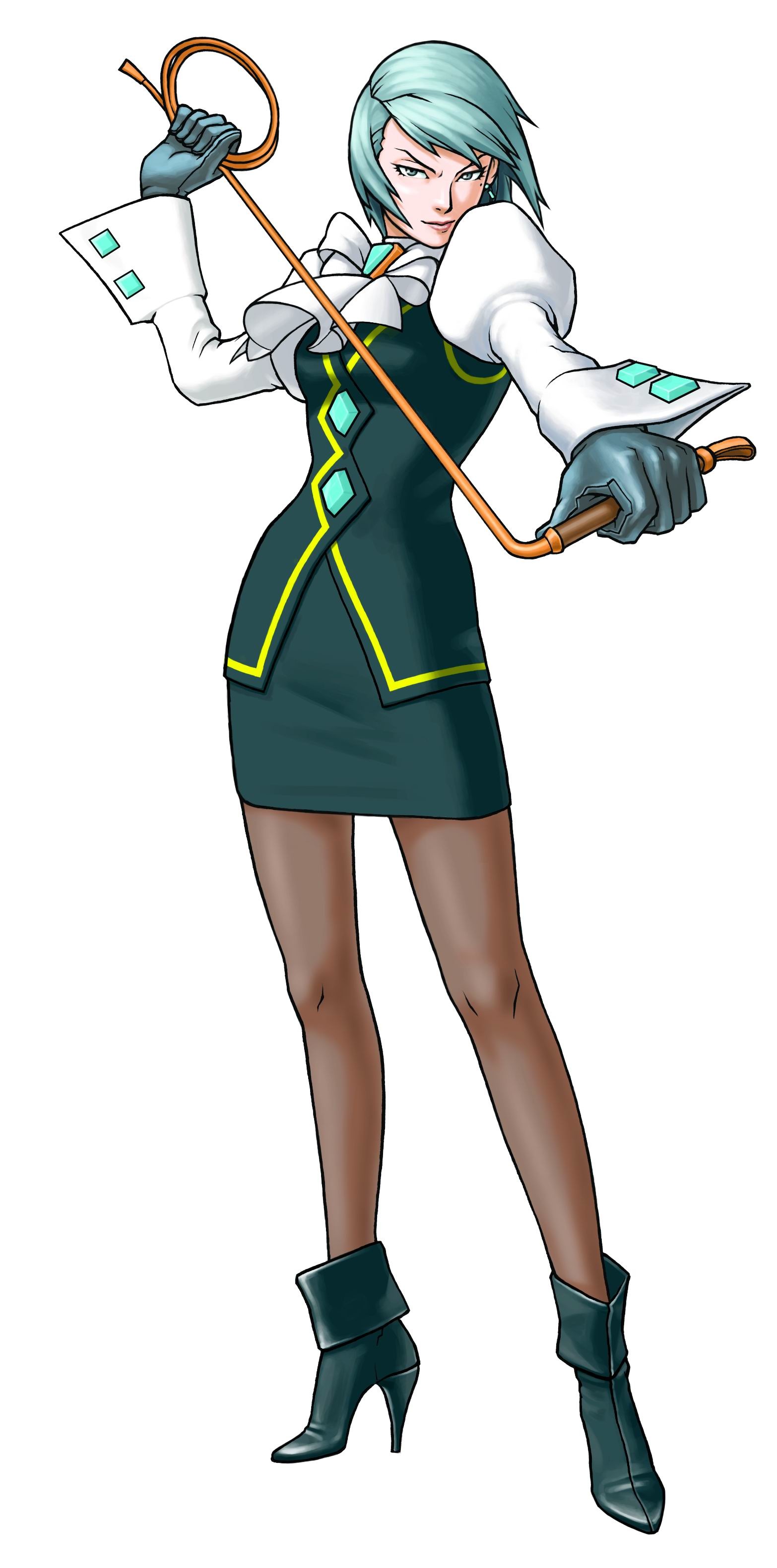
But the absolute stars of the game and the prime examples of the series's great writing is the prosecutors, particularly Miles Edgeworth and his adoptive sister, Franziska von Karma.  

Purple suit and a cravat?  MAXIMUM SWAG DETECTED.
That whip is worrying.
At the beginning of their respective games, both Miles and Franziska play the roles of the snobby rich villains you've seen in every 1980's sports movie ever (talking down to Wright, calling him a fool and such).  But after Wright eventually defeats them, tarnishing their perfect win records (the thing they based their entire life's motivations on), they begin to have changes in their personality and eventually become friends to Wright.  They grow as characters, and the player grows to like them.  For example, when I started playing the game, I couldn't stand Edgeworth for his aforementioned snootiness.  But, as time went on, and I saw his growth from snooty villain to kind, yet still socially awkward, hero, I actually began to root for him.  Now, I can even say he's one of my favorite characters in gaming.  He's got a sick cravat, he's a closet nerd, and he has no idea how to deal with women, though they seem to latch on to him to a great extent; what's not to love?

His only weakness is camaraderie. (Seriously, he's trying to flee because he felt uncomfortable with everyone being happy.)
I must admit these games aren't perfect, however.  The gameplay is a little bit too structured, making it seem like you are just going through the motions the game is giving you rather than making it seem like you are the great detective and lawyer the game makes you out to be.  And, like most adventure games, there is often one solution to problems that may not seem obvious at first, leading to some puzzles going from puzzling to aggravating very easily.  This also aggravates me because I could always think up several flaws in a witness's testimony, yet Wright has to find the most convoluted way to prove their lies.  Also, the story has some major flaws at times, such as the fact that the police almost NEVER consider things as important as motive in their investigations.  Finally, I must say I don't really like Phoenix.  He's the clumsy, sarcastic, yet easily flappable everyman they we are supposed to latch on to and identify with, but I found him to be too much of a wimp and really, a very shitty lawyer. 

Yet, despite the flaws, these games are great.  Unique, witty, and all around fun.  AND ONLY 5 DOLLARS.  FOR THE LOVE OF GOD, BUY IT.

Sunday, July 29, 2012

The Curious Case of Edward Nigma

The Riddler hates two things - idiots, and dust on his suit.
As I hinted, this week, I will be talking about my favorite Batman villain - the Riddler.  Why the Riddler, instead of more famous villains like the Joker or Two-Face?  Well, for starters, I have gotten sort of bored of the Joker recently, due to his overexposure in media and culture.  Yes, the Joker is the perfect Batman villain, and maybe even the perfect villain, but there are just so many times you can see him that you can get bored of perfection.  I still think the Joker is the best Batman villain, but my favorite continues to be the Riddler.  As with Two-Face, I must admit that Harvey Dent is indeed the most tragic of Batman villains, but he is rather one note to me.   Harvey's internal dilemmas are always handled well, but considering the half dozen times his face has been fixed and then scarred again, it seems to me like writers don't know what to do with him.

So, if not the two biggest Batman villains, why the Riddler as opposed to other secondary Batman villains?  Well, to me, all great Batman villains test something in Batman.  Joker tests Batman's morality and sanity.  Two-Face tests Batman's guilt and conscience.  Ra's al Ghul tests Batman's dedication to his mission.  Bane tested Batman physically.  Even the Scarecrow tests Batman's phobias and the control of his fears.  The Riddler, however, is one of the few villains that Batman faces that truly tests Batman's intellect, and puts one of Batman's many titles, "the World's Greatest Detective," to the test.  He really is a niche villain.  And the fact that the Riddler focuses on brains over brawn, and is one of the few villains who is willing to admit he is bested without resorting to a fist fight, and that difference to every other villain, makes the Riddler just such a distinct and charming villain.  Like the Penguin, he's a gentleman in a villain role.

Ladies, please contain your orgasms.
Another reason I like him is because of his almost lovable despicableness.  He may be a gentleman, but GOD DAMN does he love being a villain, and this is infinitely more enjoyable to me than a tragic villain (sorry, Harvey).  A villain who has fun while he's being horrible has a certain charm to him, and the Riddler has this in spades.  For example, in the recent blockbuster video game Batman: Arkham City, Batman must solve the Riddler's challenges unless the police officers that the Riddler captured would face fatal consequences.  And, completely true to character, the Riddler cheats and has no remorse if Batman fails.  In fact, he responds gleefully to it.  It means that he WON, dammit, and that's all that matters to him.


But the problem that the Riddler has is that, in most media and even in the comics, he is presented as a doofus or just plain annoying and childish.  It's not a problem that he is arrogant and obsessed with getting attention; that is the flaw of his character that makes him easily defeated by Batman.  Like all classic villains, the Riddler often underestimates his foe, and that leads to his downfall.  (Another villain with this problem is Dr. Doom, who I will reference later.)  But this arrogance and desire for attention is exaggerated in the Riddler to almost childish degrees, leading to him acting like a buffoon.  Take a look at his trophy from Arkham City.  Does this look like a person who has one of the greatest intellects in the DC Universe?

OH SHIT!  I FORGOT TO GET DOWN ON FRIDAY!
Like I described, there is no problem with the Riddler having a flaw with his arrogance.  But Dr. Doom has this and still manages to be threatening.  I see the Riddler almost like a mix of Jigsaw from Saw films and a college professor.  He is menacing and completely sociopathic in his pursuit to prove he is smarter than Batman, but he still contains a certain elegance and chivalry in him that he acts like he is  superior to Batman, as if Batman is a neanderthal in comparison to the Riddler's classy ways.  I would also prefer if the Riddler really did seem like the genius that he is.  He should be like the villain in a thriller: always one step in front of the hero until his character flaw (arrogance), creates the opening for the hero to succeed.  

In other words, I want the Riddler to get the respect he deserves and could possess.  I honestly think that the Riddler could be one of the most feared villains in Batman's rogues gallery instead of just a joke character.  Some comics, like Batman: Hush, have hinted at his brilliance, but I think there is a long road for the Riddler to take in order to be up with the Joker or Two-Face.  Of course, he might have to lose the lame Green and Purple suit...would this be better?


  Oh yes...that would do quite nicely.

Sunday, July 22, 2012

Bane and "Eye on Design"

Before I begin, I would like to offer my condolences to all the families and victims of the Aurora shooting.  I know that probably means nothing, since no one from there will ever read this, but I still wanted to say something.  I will definitely talk more about this event and the media coverage of it, but not until all the facts come in and we have had time to grieve and completely analyze everything.

This is not only a special The Dark Knight Rises post, but also features a new type of post called "Eye on Design," where I analyze the character design of certain characters.  Today, we will be talking about the history and brilliance of the main villain from The Dark Knight Rises, Bane.

COME AT ME, BRO!
Bane is the epitome of a character that should have only been used once, but how that one appearance could have been remembered forever.

Bane had a hard life.  In the corrupt South American nation of Santa Prisca, a young Bane was forced to serve his father's life sentence in prison.  At this time, Bane was just a child.  Yep, the leaders of Santa Prisca made a six year old boy spend his life in prison.  Aren't comic book villains just great?  Yet, young Bane made the "best" of his prison life.  If by "best," you mean hiding a shank in your teddy bear and killing your first man before you even learned to shave.  He also read and worked out, though, if that's any consolation, becoming vastly intelligent and athletic in the process, and he soon became "king" of the inmates.

Seeing the boy's progress, the wardens of the prison began to fear Bane's potential and thus entered him into a scientific test of a new drug called Venom.  All previous applicants had died, and the wardens expected the same result.  But Bane wasn't going down that easily.  In a showing of almost godlike resolve, Bane hung on, and the Venom made him even stronger than before, creating the muscular abomination seen above.  With his newfound power, Bane escaped the prison and gave himself a new goal: to destroy Batman.  Throughout his life in prison, Bane heard countless stories and rumors of the almost mythical figure of the Caped Crusader.  Bane is convinced that Batman is the mythical bat creature that has haunted his dreams as a boy and is determined to destroy the Dark Knight at any cost.

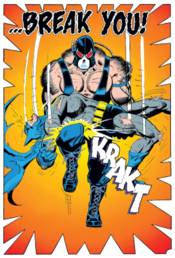
But instead of simply charging at Batman like any other villain would do, Bane did something that I think is rather novel for a comic book villain: he waits, and he plans.  First, Bane destroys the walls of Arkham Asylum, where most of Batman's rogues gallery is held.  Then, Bane watches as, night after night, week after week, month after month, Batman struggles to recapture all of his foes and wears himself out in the struggle for order and peace.  It is during this time that Bane, through the simple tactic of observation, determines Batman's identity.  Finally, months later, Bane does the unthinkable.  He attacks an exhausted Bruce Wayne IN WAYNE MANOR, beats Batman to the brink of death, and then, in possibly the greatest splash page known to comic books, Bane "breaks the bat."
Dozens of Batman fans' minds were blown at this moment.
Batman's back was broken in half.  It was doubtful Bruce wold ever walk again, much less be Batman. And the comic world was shocked.

But that's not the end of the story.  Bane soon takes over Gotham city, but, as he would soon find out, he wasn't done with Batman just yet.  See, you could break the Bat, but you're still leaving him alive.  And just breaking him just makes Batman angry.  That's right: Bruce Wayne decided to recover from his injury and once again take the mantle of the Bat, showing again the amazing resolve the Dark Knight is known for.  But, in the time it takes to recover from a BROKEN BACK, Bruce recruits fellow vigilante Jean-Paul Valley, also known as Azrael, to take up the mantle of the Bat.  Azrael's backstory is kind of lame, including a secret order and him possibly being a clone or test tube baby, and if that interests you, you just read the Wikipedia.  Valley's Batman costume will be the subject of my "Eye on Design" section of this post, so we'll get to him in a bit.  For now, let's just finish up the story.

Bane is eventually defeated by Valley, who uses a knife to cut Bane's Venom steam.  See, while Venom gives Bane amazing strength, it also is incredibly addictive.  Imagine heroin times...say, A MILLION.  Immediate withdraw kind of stuff.  A weakened Bane is then severely beaten by Valley and sent packing.

And you know what?  That should have been then end of it.  Bane had his glorious moment, and his defeat should have ended his campaign.  He did what he set out to do, and we should have seen him decide to move on after his defeat.  It would have shown how different he was from other villains.  He succeeded in his task, but only failed in the aftermath.  He should have just moved on with his life.  But, of course, Bane was too much of a money-maker to just let go.  Ever since his premier story arc, Bane has been featured in multiple story lines.  Some good, some great (such as his time on Gail Simone's Secret Six), and some just plain stupid (such as when he thinks he is Bruce Wayne's half-brother and fights crime with Batman for a while).  He's been on and off the Venom wagon dozens of times.  It really just seems like nobody knows what to do with Bane after his shining moment.  Simone's run on Sinister Six was definitely the best, and I would highly suggest taking a look.  Not only do we see a sympathetic side to him as he tries to act as a father figure to his fellow teammate, but he's also hilarious at times, if in a sad, kind of pathetic sort of way.

Prison life doesn't teach you how to romance ladies,  apparently.
Not only does he respect Batman, he has no idea how to handle children.  A man after my heart.
I know The Dark Knight Rises' Bane is similar to Bane in name only, but he's still an amazing character, and I find it hard to understand why anybody would hate him, as I've seen with other comic readers.  Is he misused?  Sure.  Has he gone on longer than he should have?  Of course.  But, in that one moment, Bane made every Batman reader hold their breath.

But now, for an "Eye for Design."  As I said, Jean-Paul Valley took over for Bruce Wayne when Bruce was recovering from his...incident.  And Valley adopted a more sleek, more technologically advanced suit.  As seen here.

What is it with comic book characters and the "Come at me, Bro!" pose?
So, what works here?  Well, for me, I like the following
  • The mask: For me, when it comes to masks, I think the simpler and less detail, the better.  With full masks like this and on Marvel's Deadpool, the mask mainly covers the mouth, and leaves more room for showing emotion through other means, especially the eyes.  Instead of gritted teeth, a frown, or a smile, full mask characters have to have more expressive brows and shading to properly express their emotions.  It creates some interesting art and some interesting expressions.
  • The Gloves: These just have a great, visceral look to them.  These things are not only full of tech, but they can climb walls due to the sharp fingers and can most likely punch through fucking concrete if they can.  They look like they have POWER in them, which I like.
  • The Cape: I can't really pinpoint what I like about it.  I like arching points to them, and the jagged edges, I guess.  It just really looks great in art and gives him a very jagged and angular look, which really makes him look...well, like a bat.
But what doesn't work?  Well...everything else.  I mean, GODDAMN, this suit is a fucking mess.  First of all, the color scheme is completely ridiculous.  Gold, Red, and Blue?  This isn't what the "terror of the night" is supposed to look like.  He looks like he should be at a Soccer Game rooting FC Barcelona, not striking fear into the hearts of men.  Also, we appear to be taking a page from the Rob Liefeld school of character design with huge shoulder pads and random leg belts that have no practical meaning.  Also, what's with the belt with no buckle?  And the Megaman collar he's sporting here?  Why does he have armor all over his shoulders and chest, but his legs only have spandex?  It looks like he is half dressed or just forgot the rest of his costume somewhere.  What are those prongs sticking out of his legs?  Do they have any point?  Did the designer just look at Batman, see the prongs on his wrist (where, you know, they would actually have some functionality) and say "Oh shit, I should probably put those on Jean-Paul somewhere."  I mean, this whole thing just doesn't work and screams "90's."  It's opulent and impractical.

Check back next week as I go into the plight of my favorite Batman villain.  Who?  I won't tell until then.

Saturday, June 9, 2012

Update and My Top Ten Protagonists (Part III)

So, yeah, it's been ages since I have updated this blog, but now that my summer has become fairly regular, I can now have regular updates.  Expect to have at least one every Saturday or Friday, depending on work schedule.  I was going to have a video up last week of the entire countdown, but considering I am, frankly, awful with Apple's iMovie (all of my training has been in Final Cut), I had no idea what to do.  So...no videos until I can use Final Cut (maybe when the new school year starts?)

Now, to finally finish up this countdown, so we can move on to more important and relevant topics.  I must admit that I do not like doing lists that often, but I felt it was a good way to get people introduced to what I like and what I like to see in video games.  Hopefully, these last four entries to the list will show my preferences in character and in video games.  

4) Isaac Clarke (The Dead Space Series)
"What're YOU lookin' at?"
Man, do I love Visceral Games.  You can really tell that they really care about their projects and creating full, vibrant worlds to accompany their games.  Looking at Dead Space, you would never expect that a game about splitting up creatures straight out of John Carpenter's The Thing would not only have a fully fleshed out world, including a commentary about cults and religions like Scientology, but there it all is.  It truly is in all of the little things that suck me into Visceral's romps.  Thus, I always find it kind of disappointing that some people hate on Visceral and their well-crafted games for the silliest of reasons.  Yes, they aren't perfect, I would admit that, but I've heard several people say that they disliked Dead Space because of its "Your Mom Will Hate It" Ad Campaign.  To hate on a game because of the stupidly of its publisher (EA especially, whose stupidly can reach baffling levels) seems a bit petty when the game itself is not affected.  It's not like Mass Effect 3, which was, in many ways, ruined by EA's meddling.  Besides, without that campaign, as silly and childish as it was, we would have never been introduced to this woman:

I have no idea who this woman is, but she is the coolest and funniest woman I ever seen.  And my life is only brighter after seeing this video.

But that's besides the point.  We're here to talk about Isaac Clarke, Dead Space's protagonist.  Now, Isaac seems to violate my rule about silent protagonists.  But the thing is...he isn't and never was.  Even in Dead Space 1, Isaac wasn't truly an empty vessel like other silent protagonists.  Not many people are aware of this, but the next time you boot up Dead Space 1, look for Isaac's notes on the Objectives Menu.  It's there  the player learns Isaac's hidden personality.  The verdict: Isaac is a...dark individual.  He's sarcastic, depressed, and even mean-sprited.  He calls people "psychopaths" and "maniacs."  He loathes the Unitologists.  But, unfortunately, this personality was hidden underneath the silence and robot nature, and it's not until the very end of the game that we see that Isaac has more violent emotions that we see in Dead Space 2.  I think the developers wanted Isaac to be a vessel in the first Dead Space, but they realized this wouldn't work for a truly interesting game.  

But, when we compare Isaac from the first game to him in the sequel. Please watch this video from the guys at Extra Credits:


Now, the lesson here is that though you might have a silent protagonists.  That does not mean you do not know anything about him or her, and you can just make up anything you want.  Just because a character doesn't speak doesn't mean that the character has no personality.  Personality is conveyed through actions as well as words.  And the developers at Visceral did a fantastic transition.  They took the little we knew about Isaac from DS1 and fleshed out the character in DS2.  And, yet, nothing was out of place.  I never felt like I was being introduced to a new character in DS2, just the same character finally given the chance to speak.  The dark, confused, sarcastic individual from the original is still here.  

But what makes him a great character besides this transition, is the fact that Isaac, more than most characters I have played, feels like a real person.  He has the same reactions I did to the situations he was in.  Sometimes word for word.  And that's what's brilliant about him.  He not only is a separate and unique personality, but still reflects the personality of the player.  He can be a vessel for the player like originally intended, but still be a unique character.  And that kind of balance makes Isaac such a wonderful marvel of character design.

In addition, the idea of madness in video games is something that has been used often and very effectively, but Dead Space 2 knows how to use this in a fantastic way.  It uses the confines of the medium to truly put you on edge and show you what Isaac is going through.  A great example:

A great set piece and fantastic way to convey insanity and produce horror.  I look forward to what they do in Dead Space 3.  Apparently, they plan to have a "Dark Isaac" who will insult you along your journey, and I think this can not only be a greater opportunity for humor, tension, and more of these kind of QTEs.

3) Dante (Dante's Inferno)
I don't think you can get more badass than this.
Oh Visceral, I wish EA would stop ruining your games with their ridiculous advertising ploys.  But Dante's Inferno has a lot more going against it.  First of all, it's title.  Now, I had no problem with the title. I simply saw it as Visceral presenting Dante Allegheri's version of Hell.  Was it silly to make the Italian poet into a bulky Crusader?  Sure.  I personally think it would have better to name the main character and his love something else, (let's use "Mario" and "Peach" for this whole post, since that's pretty much what the game is) and have you meet the real Dante Allegheri along the way, such as when you talk with Virgil.  And yes, it was a lackluster God of War clone with a half-finished ending.  These are all true, and no matter how much I enjoyed myself playing it, I can't deny that.  (But, seriously,  how fun was it doing this?)


But the thing is, if you asked me if I would prefer to play God of War or Dante's Inferno, I would pick Dante's Inferno every time.  And you know why?  It's because "Mario" is just a much more interesting and original character than Kratos.  While Kratos is just a big ball of rage than blames other people for all of his problems (most of which, he himself caused), "Mario" is quite the opposite.  He blames himself for all of his problems, even when they might be other people's faults.  He is the epitome of Catholic guilt and Puritan thinking, whenever something has gone wrong, it is because he has made a mistake or because he doesn't understand.  It is through this self-deprecation that we learn what it was mostly likely like to be a Crusader.  He, like many others, thought he was being absolved for his sins by partaking in his conquest, but he was misled.  I feel like Visceral could have done a better job with "Mario's" crisis of faith, but the fact that he wasn't raging against the machine made him a big step up from Kratos.

But something else that interested me was "Mario's" pursuit of "Peach."  Now, if "Mario" was just another Kratos clone, he would most likely would have just have had a had a sex mini game with her corpse and then continued on his angst filled journey.  No, there was something more to "Peach" that motivated him to trek through nine levels of hell.  If "Peach" was just another set of rocking tits, he would have never have done so.  "Peach" represents the last shreds "Mario's" humanity, the last threshold between a sane, normal life and complete insanity and life as...well...Kratos.  This makes "Mario's" quest seem much more weighty than whatever revenge fantasy Kratos is cooking up.  

But all of this together, the epic quest, the self-deprecation, and the Catholic guilt, make "Mario"a deeply sympathetic and original character.  I only wish he had more to do than his usual "save the princess" quest.  It's epic and significant to him, but they could have done so much more.  He has such a rich personality that we could have had many more deep and interesting tales to tell.  Sort of like our next entry...

2) James Sunderland (Silent Hill 2)

Oh, James, you magnificent, yet miserable bastard.  If only you knew how amazing you and your game Silent Hill 2 was.  Maybe it's because you are Silent Hill 2.  Yes, from the enemies, to the bosses, to the environments, and the Otherworld, all of Silent Hill 2 was designed specifically with James and his fragile psyche.  Now, there are going to be some major spoilers here, so if you don't want to know why James is such an impressive feat, stop reading here and just go to number one.  The big revelation of the game is that James's wife contracted a serious illness that made her face scarred.  Feeling that she looked like a monster, James's wife lashed out at James, verbally abusing him at every chance.  Therefore, James avoided her, turning to drink.  Eventually, due to his sexual frustration and deteriorating patience and sanity, James smothered his wife, putting him and her out of their misery.  Or so he thought.  Unfortunately, Silent Hill has a way of bringing those demons back to light.

Let's just give two examples of how Silent Hill 2 is tailor-made to James's mind.  The first would be the infamous sexy nurses.
Should I be aroused or terrified?  Both?
These nurses aren't just meant to titillate  the teenagers playing this game.  Far from it.  These nurses represent the sexual frustration of James.  It's been years since he has had sexual release and, since he has spent ages in a hospital for his wife, James's libido is all over the place, including a potential nurse fetish.
He is judge, jury, and executioner.  Also... a rapist.
The infamous Pyramid Head, on the other hand, represents James's inner, subconscious desire for punishment for the action of killing his wife.  On the outside, James rejects he did anything wrong, and thus he runs from Pyramid Head any chance he gets.  As time goes on, the monster slowly creeps up on James, just gaining and gaining on him, just as the guilt slowly builds from James's subconscious to his consciousness.  But when he finally faces the truth, when he finally can't deny his guilt anymore, the Pyramid Head monster does not kill him.  Rather, the monster falls on his own sword.  He moves past his guilt, or at least admits to it.  It is then up to the player how James reacts to this.  Does he accept it with grace and move on with his life?  Or does he fall into misery?  Or does he get abducted by aliens or meet a dog in a control room?  OK, those last two might not have been relevant, but you get what I'm saying.  

James and Silent Hill 2 are the perfect representation of how gams can use their own confines of their medium to tell amazing stories.  The game took the basic confines of a game (enemies, bosses, combat) and used them to not only make a terrifying, harrowing experience, to tell the story of a tortured man.  If more games followed SH2's example, more games could tell brilliant character pieces.  Such as my number one protagonist...

1) John Marston
The face of a goddamn American Hero...
If I had the opportunity to make a movie based on one game, it would be Red Dead Redemption and the tragic story of John Marston.  That's how good his story is.

Let's start from the basic level.  John Marston has almost everything I love about a character: sarcasm and a silver tongue, a set of strict principles (which well fits the time, but also allows for player freedom (to a degree, which I mention later)), and a personality that allows for fantastic discussions.

Now let's go through all of those and explore why they make John so amazing.  The sarcasm and silver tongue just make John likable.  But the writing on his wit is so perfect that he has the amazing ability to insult people without them knowing.  He has a perfect was of having barbed language without facing retribution.  But it is also through this wit that we learn that he is probably the smartest and wisest man in the game.  He may not be learned or even literate, but when he mocks the people he comes across, no matter how "intelligent" or "learned" they might be, they are mere children compared to the man who has seen and done all.  There are even times when John can be presented as just plain dumb when compared to Nigel West Dickens or another "intellectual", but never ignorant or gullible.

But, due to his principles and his resiliently kind personality, John never comes across as bitter or as a sad sack, such as Max Payne in his most recent outing.  At worst, John just seems tired.  And this exhaustion is key to his character.  All he wants in the world is to go home to his wife and child, and the government is preventing that.  But he still tries to help everyone he can.  Maybe, he feels, if he helps out these strange people, he can resolve the grievances of his past.  And this is how John can expose himself to a variety of conversations.  Conversations, I believe, that expose the best parts of the game, the writing.  It is when John rides on horseback with the people he serves (and he tends to serve both sides of an issue just because he is that unbiased) that he can hear both sides of the argument.  He can ride with a Mexican revolutionary and hear how Mexico needs freedom.  And that revolutionary can convince you, the player,  that she is right.  But John seems nonchalant and at best amused.  As mentioned before, he has seen too much to truly get excited about every new revolution.  But then he can ride with a member of the oppressive Mexican government, and then that person can convince you that Mexico needs a strong government.  But once again, John just sits there and listens.  He acts a catalyst for conversations, but due to his strong backstory, he continues to be motivated by his desire to be reunited with his family, and nothing more.

But, the principles of Mr. Marston also allow him to be such a well written character that it sometimes feels that you can play the game incorrectly.  Normally, I am against such an idea.  A game should never have a wrong way to play it because that is the sign of bad writing, but in this case, the writing of a character is so well done that it is the gameplay that is in conflict with the story, rather than the other way around (once again, Mass Effect is an example of this.  A friend of min said I was playing the game wrong and thus didn't enjoy it.  If that's the case, then it's not a very well designed game to have several "wrong" avenues.)  The best example of this is doing dastardly deeds as John.  Many people have pointed out that John openly refuses the local prostitutes, as he is a Christian man who is faithful to his wife.  But then he has no problem tying said prostitutes to the railroad tracks and watching them get run over.  However, I believe that John is so well written as a man trying to solely good (or as much good as he can) that tying a woman to the tracks actually goes against the established character.  I feel that Rockstar should have excluded this from the game or at least have John mention how he despises himself for doing something evil.

But the true beauty of John Marston is (SPOILER!) his death.  His death is the only thing in video games that made me cry.  Let me set the stage: you finally killed the last of your old gang, including your mentor and father figure.  You spend a few days with your family.  Reconciling with your wife and son, both of whom are angry with you for endangering them.  You save your son from a bear attack, and he finally admits he forgives you for leaving them for your mission.  It looks like John can finally have the peaceful life he has been striving for for all that time.  But then the government comes.  What?  The deal was finished.  Agent Edgar Ross said he would leave you alone?  But now he asks whether you truly thought he would let a murderer live...even though he made you kill your old gang members.  There is a long shoot out between you and the army, as your friend is killed in action.  And then, as the army closes in, you have this brilliant moment:


I admit, I welled up.  I might have even shed a tear.  This is a character I learned to love over the course of my play through.  And to see that there was no happy ending, no riding into the sunset...it just tore my heart out.  This is something no other game could do.  Not even GTA4.  Niko Bellic was a thug, a man who easily slid back into crime when he claimed he was trying to get away.  John Marston was forced, and when he finally and reluctantly fulfilled his end of the bargain, he was betrayed.  No peace.  No redemption.  Only loss.  And the looming threat of death that hung so heavily over John Marston finally came swooping down.  And you are left there to sit and stare.  

Brilliant, tragic stuff.  Stuff that no other game has been able to do and that no other character was able to convey.  I only hope Rockstar, and any other studio can create amazing moments like these.

I hope you liked this countdown.  Let the normal posts begin...NEXT WEEK!